


The Orrery is a fortnightly newsletter on space power and policy, written from an Indian seat. Every edition will have one analysis of the most consequential development in the space domain. This inaugural edition runs longer than the rest will.
The cost of space launch has plummeted. At an average of $3,868 per kilogram to orbit, it is at an all-time low. In all likelihood, it will continue to fall.1 Correspondingly, the demand for space launch has never been higher. Orbital launches nearly quadrupled in a decade, from the mid-eighties in 2015 to well over three hundred in 2025. Annual launches now exceed anything seen even during the height of the Cold War.2 And most of this growth comes from privately developed rockets.
Counterintuitively, satellite firms are struggling to find launches.3 The record-low price and the closed launch manifest come from the same source—SpaceX. Three-quarters of the world's payload mass now flies on SpaceX Falcon 9 rockets. The company is now beginning to wind down Falcon as it prepares to transition to Starship.4 Customers report difficulty buying a Falcon launch after 2028.5
The crunch indicates a scarcity of private launch vehicles. The study that produced the $3,868 figure found a structural break in 2010 and attributed it to Falcon 9 entering service on a NASA contract.6 The fall in launch costs can be traced back to state-backed anchor demand. Launch capacity, while it is being developed, is contingent on a set of state decisions. Market forces can only operate atop these decisions:
The state issues anchor contracts
The state grants access to launch sites
The state tolerates failure
The state assigns orbital rights
These four decisions operate at different points in the market but converge on the same outcome: launch capacity. Contracts create the demand; launch sites create usable supply; tolerance for failure lowers risk; and orbital rights precede space assets that justify frequent launches. They form the major pillars of launch capacity. Private firms cannot make these decisions for themselves and so private investment and competition respond to those incentives.
When these conditions are in place, private firms can compete over execution. Meanwhile, these four allocations stay in state hands. This edition demonstrates how that plays out.
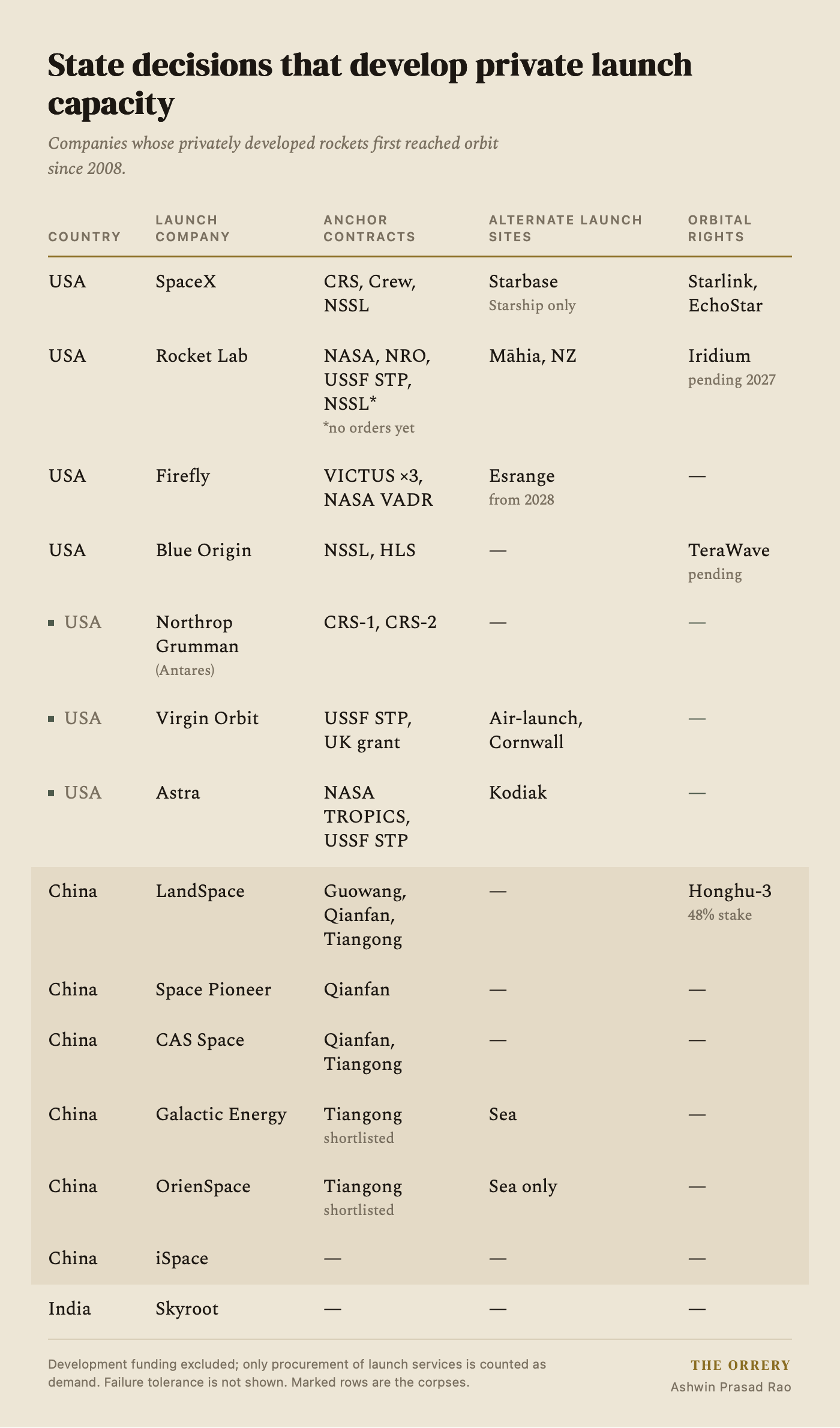
Every launch company whose privately developed rockets first reached orbit since 20087 is in the table below, the corpses included.8
The state issues anchor contracts
Emerging launch firms mostly sell to one customer—the state. Five customers accounted for 86% of Firefly’s company-wide revenue in 2025, all of it from the US. Its disclosed customers include NASA, the Space Force, the Space Development Agency, the National Reconnaissance Office, along with three defence primes.9
A similar pattern can be observed in China. LandSpace, the country’s leading private launch firm, holds contracts to fly Guowang and Qianfan satellites.10 Guowang is a megaconstellation run by a central state-owned enterprise. Qianfan, another megaconstellation, is backed by the Shanghai municipal government. LandSpace’s Zhuque-3 rocket is also slated to carry the Haolong cargo shuttle to Tiangong, the state-owned space station.11 On 19 August, that rocket became the first Chinese commercial vehicle to land its booster after an orbital launch.12 Most of its contracts are tied to state entities or state-backed programmes.
Even the commercial customers are often the state in disguise. Private satellite firms that buy launches are contracted to sell space-based services to governments. In the US, 82% of satellite manufacturing revenue came from state contracts.13 Many startups position themselves as civil and defence contractors from the outset, or pivot to it eventually.
Emerging launch firms often depend on the state to provide an initial base of demand through anchor contracts. The US is the obvious case study. The Pentagon’s FY2027 budget request provides about $5 billion for 31 launches.14 The US Space Force has also raised the ceiling for National Security Space Launch Phase 3 Lane 1 from $5.6 billion to $17 billion, as the number of expected launches under the contract grew from about 60 to 170 over the next decade.15
Meanwhile, Europe moved later to cultivate a new generation of private launch firms. None yet have proven orbital vehicles. The first will probably be Isar Aerospace’s Spectrum. It is on a €197.8 million milestone-based ESA contract under the European Launcher Challenge.16
States also have a strategic reason to spread launch demand across more than one provider: assured access. National Security Space Launch buys from multiple launch firms so that technical failure or capacity constraints in one firm will not shut off an entire class of payload or orbit. The US National Space Transportation Policy also directs procurement to support a launch industry and maintain multiple avenues for government payloads.17 The surplus also opens an option for surge capacity during wartime.18
During peacetime, this surplus can be sold abroad. These exports finance reserve capacity and give domestic launch firms a higher launch cadence. They can also make foreign space powers structurally dependent on the exporting state’s launch industry. Reliable and inexpensive imports can weaken the economic and political will to maintain a more expensive indigenous space launch capability. When relations sour or interests diverge, foreign launch dependence can stop being benign. The American experience with Russian RD-180 engines after Russia’s annexation of Crimea, and Europe’s sudden loss of Soyuz access after the beginning of the Russia–Ukraine war in 2022, show how an ostensibly commercial relationship can become an assured access problem.19
The state grants access to launch sites
Launch capacity is also fenced-in by access to launch infrastructure. Along with launch vehicles, launch sites also need to grow. In the US, Wallops Flight Facility and Kennedy Space Centre have seen 467% and 252% increases in launches between 2020 and 2025. They could hit their ceilings by 2028–2029.20 Even Cape Canaveral is nearly out of pads after the recent administrative allocations by the Space Force.21 With Vandenberg also running out of room, the country needs a third heavy-lift site.22 The Space Force Chief of Space Operations has warned that they may have to cap launches.23 Range capacity is also constrained by airspace, sea clearance, tracking and common-use infrastructure. New pads alone cannot solve the problem.
A single launch site can become a single point of failure. Blue Origin’s New Glenn rocket exploded during a hot-fire test in May, destroying the rocket and damaging its only orbital-class launch pad.24 I don’t think the company can return to flight before 2027.25 Its first lunar lander mission has already slipped to early 2027, and its second-stage testing has moved onto a NASA stand.26 The delays may also affect American lunar timelines.
Geography has a strong bearing on which orbits a launch site can reach efficiently and safely. Cape Canaveral is not an ideal launch location for southerly polar trajectories. Spent stages can overfly inhabited areas. Floridan launches to polar orbits need constrained corridors or dogleg manoeuvres. Vandenberg is better suited for it.27 Launches from Māhia, New Zealand, on the other hand, enjoy open oceans to the north and the south. Similarly, launches from equatorial latitudes can reach low-inclination orbits more efficiently. Launches from polar latitudes like Esrange are better for polar and sun-synchronous orbits.
Sea launch addresses some of the geographical limitations of fixed pads. A vessel can sail to a desired location and the rocket can launch from it. The Chinese firm Galactic Energy flew the first sea launch of a privately developed rocket in 2023.28 Its Ceres-1S rocket launched from a mobile platform in Haiyang in Shandong. Galactic Energy also flies from Jiuquan, so the sea platform is an alternate launch option when launch sites on land are unavailable. OrienSpace, another Chinese launch firm, followed this up with a sea launch of its Gravity-1 rocket in the Yellow Sea. It flew again this year, from the East China Sea, through some of the busiest shipping lanes in the world.29
These sea launches depend heavily on state assets and support. Galactic Energy’s launch was organised and commanded by the sea launch team of the Taiyuan Launch Centre. Haiyang has operated as a remote base of Taiyuan since 2019, and a second maritime facility is planned near Yangjiang in Guangdong.30 The vessels, the piers, the processing halls and the command structure are state assets made available to private firms.
States can also create geographic redundancy by enabling access to foreign launch sites. Washington and Wellington concluded a Technology Safeguards Agreement (TSA) that clears the path for American launch technology exports to New Zealand.31 Using it, Rocket Lab launches from Māhia, which hosted more orbital launches last year than the home sites of any country except the United States and China.32 A similar agreement was signed with Sweden, which allows Firefly to access the Esrange launch site and even license its rockets out to Sweden.33
Through foreign launch sites, the launch firms gain more than just access. Sweden has committed roughly a billion kronor to military space capability through 2032 and designated Firefly as the primary launch vehicle provider.34 Rocket Lab’s launches from Māhia have also carried Japanese, South Korean and European payloads.35
Access to launch sites, primary and alternate, is allocated by states through treaties and state support. Alternate sites provide the respective state with the ability to retain space access when it is not able to do so from its home base due to war, adverse weather, damaged pads or any other reason. The pads at Cape Canaveral are administratively allocated to certain launch firms. They can be revoked.36 The maritime spaceport at Haiyang was state-built, and the private sea launches were state-commanded. Esrange was built, funded and anchored by Sweden. Māhia needed a treaty and an act by the New Zealand Parliament.37 While the launch vehicles are privately developed, their launch access is still very much authorised by states.
The state tolerates failure
Developing a launch vehicle takes many years. SpaceX took six years to reach orbit, Rocket Lab took twelve, Firefly—eight, LandSpace—eight and Blue Origin—twenty-five.38 Announced timelines rarely stick. Delays are the norm rather than the exception. Throughout development, launch firms can go years without generating launch revenue. In the meantime, the capital requirements are exorbitant: firms must build and maintain factories, test stands, engines and a workforce for over a decade.
Among the companies in this table, first flight attempts failed about as often as they succeeded. SpaceX’s Falcon 1 failed three times before reaching orbit, Rocket Lab’s Electron failed its first flight, as did Firefly’s Alpha, LandSpace’s Zhuque-2 and Virgin Orbit’s LauncherOne. Galactic Energy, OrienSpace, iSpace, Blue Origin and Skyroot succeeded on their first try.39
Launch firms don’t graduate out of failures even after a streak of successes. Despite its track record, SpaceX’s Falcon 9 suffered a failure in its second stage in 2024.40 Rocket Lab lost a payload on its forty-first flight.41 Two days later, Galactic Energy’s Ceres-1 lost its payload on its tenth flight.42 Reliability minimises the rate of failure rather than eliminating it altogether.
The costs of failures are high. In the New Glenn booster explosion, Blue Origin lost its transporter-erector and lightning towers, and suffered damage to its lone orbital-class site—the one it had spent a decade building.43 Three days before the explosion, NASA awarded Blue Origin two contracts worth $188 million to deliver rovers to the lunar South Pole.44 New Glenn is also central to Blue Origin’s role in Artemis.45
States are most willing to carry launch firms through failure when they value the capability the firm is expected to preserve or create. After the explosion, NASA began examining alternative launch options in case New Glenn could not meet the Artemis III timeline.46 But NASA did not remove Blue Origin from the Artemis Programme. The Space Force had awarded Blue Origin a National Reconnaissance Office launch task order only hours before the anomaly. After the explosion, it publicly reaffirmed that the Space Force and NRO remained committed to working with Blue Origin.47 Japan’s H3 rocket has failed twice and lost expensive payloads. The government nevertheless continued the programme, and H3 returned to flight successfully in June 2026.48 LandSpace raised money from the state-backed China SME Development Fund and a Huzhou government fund in 2020. Zhejiang and Jiaxing later backed the construction of its production base. LandSpace’s Zhuque-2 suffered a failure in 2022 and reached orbit in 2023. A state-owned advanced-manufacturing fund invested another 900 million yuan in 2024.49
Where governments saw less strategic need to preserve a capability, they appear to have been less willing to absorb failure. Astra reached orbit in 2021 with a Space Force payload, but went on to fail twice in 2022 with NASA satellites. NASA moved its contracts to Rocket Lab.50 Astra retired its rocket.51 Virgin Orbit had proven air-launch capability, in which rockets are launched from airplanes. It held Space Force contracts for three Space Test Program launches worth $35 million, one of which it had fulfilled.52 It had spent roughly $45 million in the third quarter of 2022 alone.53 The UK government sponsored its flight from Cornwall, UK, which failed. The US had Rocket Lab flying the same class of payloads from two continents. The US also had air launch capability from the Pegasus rocket. Neither country stepped in to preserve Virgin Orbit before it declared bankruptcy. I attribute these decisions, or rather the lack of any, to the fact that both states already had alternatives for the capabilities Virgin Orbit brought to the table.54
The state's tolerance for failure is expressed through political will. Launch firms are judged by the capability they bring and how much the state needs it. The judgement is expressed through regulatory and procurement-related decisions.55 These decisions send signals that private investors and launch customers rarely miss.
The state assigns orbital rights
A launch industry cannot necessarily sustain itself on launch revenues alone. Even SpaceX’s Space segment—which contains its launch business and Starship development—recorded a $657 million operating loss on $4.086 billion in revenue in 2025. The operating losses widened to $1.204 billion in the first half of 2026.56 Some of the losses are from Starship development costs. Taken alone, Falcon 9 is probably profitable by now. The study that put the average space launch at $3,868 per kilogram measured only the flight and did not factor in the development spending. But I see development as a perpetual cost that cannot be overlooked. Just as India needs the next-generation launch vehicle, SpaceX needs Starship, Rocket Lab needs Neutron, Firefly needs Eclipse. Northrop attempted to substitute away the R&D for the Antares rocket. It used imported engines but the Russian supply stopped in 2022. It is one of the dead rockets in the table. To revive it, Northrop is paying Firefly for the R&D.57
The profitability problem spans the rest of the industry. Firefly earned $159.9 million in 2025 and lost $298.3 million.58 Rocket Lab also remains loss-making, with a $198.2 million net loss in 2025.59 LandSpace’s 2025 revenue was 52 million yuan against a net loss of 1.711 billion yuan.60 At the end of 2025, China even changed the listing rules on the Shanghai Stock Exchange. Reusable-rocket companies were excused from profitability and minimum revenue conditions.61
Rather than relying entirely on external customers, launch companies can use their capacity to build downstream space assets. Starlink is the obvious example. SpaceX launched 78 times in the first half of 2026. Seventeen of those were for customers. The remaining 61 launches were for itself. Out of the 1,041 tons delivered to orbit, 908 tons were its own payloads.62 In the same period, Starlink services generated $7,548 million in revenue and made $2,844 million in operating income.
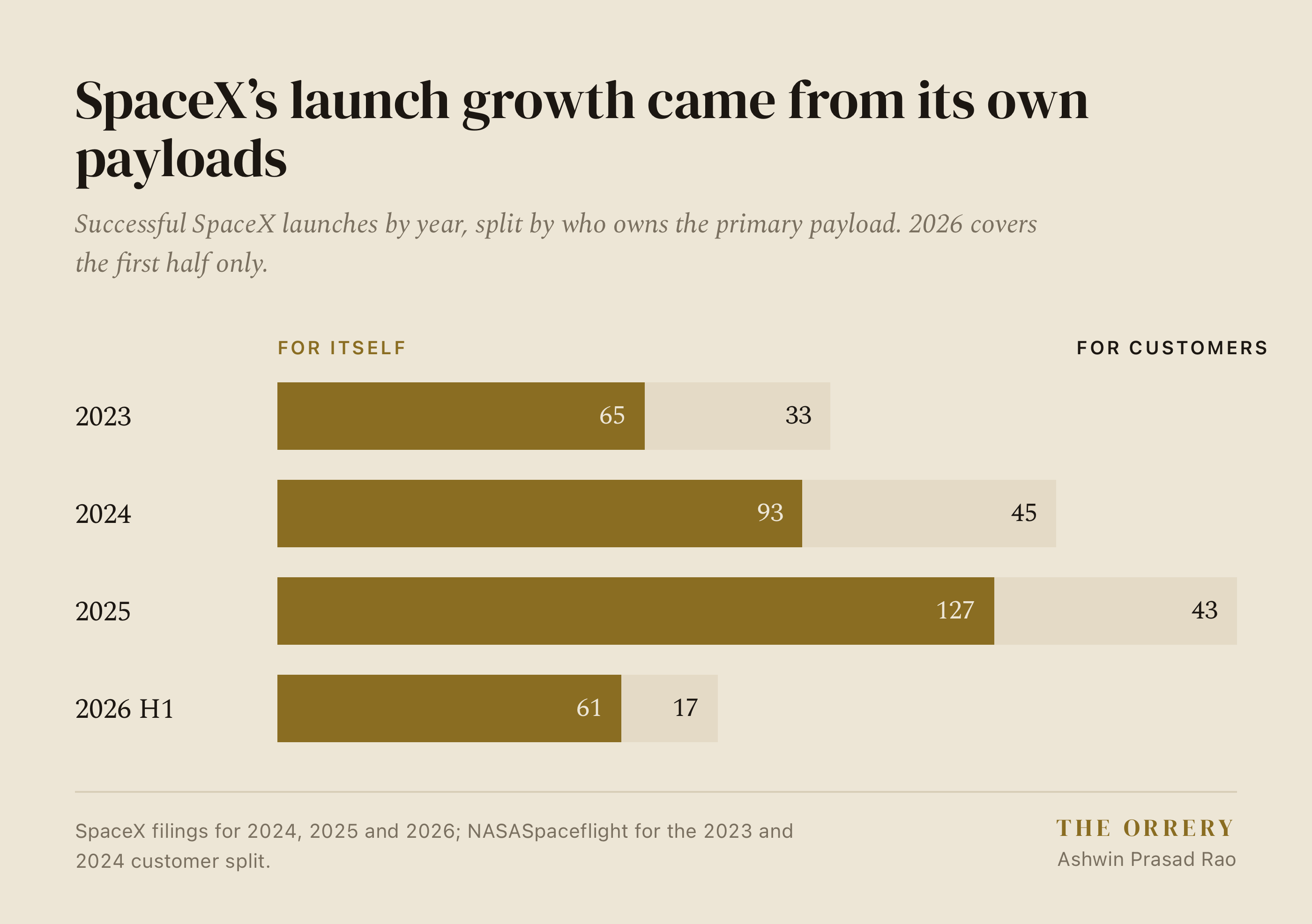
This vertical integration unleashes new models. With reusable rockets, SpaceX has been able to grow and maintain its Starlink megaconstellation at more than 11,000 satellites.63 Being its own customer also changes the perception of risk. An external customer may not seek launches on an unproven Starship rocket but Starlink will.
Megaconstellations could not have been devised with cheap launches alone. Access to massive amounts of spectrum and orbital resources is essential. These are mediated through states and the International Telecommunication Union (ITU) system. Radio frequencies and associated orbits are limited natural resources, to be used so that all countries have equitable access.64 Filings for these systems are submitted by national administrations on behalf of satellite operators, whether public or private. For non-planned satellite services, earlier filings get priority over later ones. The system therefore rewards states that file early and actually have the launch capacity to bring those filings into use.
It is no surprise that the states making the largest filings recently are the US and China. In addition to its authorisation for 15,000 satellites for Starlink, SpaceX has also applied for up to 100,000 Gen3 Starlink satellites and one million satellites in its proposed orbital data centre system.65 Amazon Leo (formerly Kuiper) has filed for close to 12,800 satellites. Around 390 of those are in orbit. Amazon and Blue Origin share a founder. Amazon already has contracts with Blue Origin for twelve New Glenn launches, with options for fifteen more.66 On its own, Blue Origin has filed for 5,408 satellites across low and medium Earth orbit for its TeraWave constellation, and for an orbital data-centre constellation of up to 51,600 satellites.67 New Glenn will have plenty of internal demand when it returns to flight. In late 2025, China filed for more than 2,00,000 satellites across roughly 14 constellations.68 Beijing was meanwhile publicly complaining that Starlink was crowding the orbits.69 LandSpace has a 48 per cent stake in Hongqing Technology. Hongqing has filed for the Honghu-3 constellation consisting of 10,000 satellites.70 Rocket Lab is buying the satellite communications company—Iridium—for roughly $8 billion. Through this, Rocket Lab gets 66 satellites, a positioning business and L-band spectrum. Iridium earned $871 million last year,71 which is actually more than Rocket Lab’s revenue.
Services like Starlink, Amazon Leo, Guowang and Qianfan could not have been devised without state licensing and orbital filings. And in the Chinese cases—even direct state backing. The Federal Communications Commission (FCC) recently approved the transfer of sixty-five megahertz of nationwide spectrum licences from EchoStar to SpaceX through the secondary market without an auction.72 Rocket Lab's purchase of Iridium also relies on FCC approving the licence transfers. The state has a hand in all these businesses.73
LandSpace is a useful case to see all four state decisions in action. Its Zhuque-3 flight on 19 August launched from Jiuquan—a state range. The company has assured demand for its rockets from China’s state-backed megaconstellations. State funds and two municipal governments supported the company through its developmental failures. Its payload was Honghu-03, built by Hongqing Technology, in which LandSpace holds a 48 per cent stake. China has filed with the ITU for 10,000 satellites for the constellation.74
As the strategic returns from orbit-dominating megaconstellations grow, these firms stop behaving like launch service providers. SpaceX has begun turning away some commercial customers seeking Falcon launch services beyond 2028. It is also winding down some expendable Falcon hardware as it transitions to Starship. Falcon rockets will prioritise NASA and national security requirements.75 Foreign customers including India cannot treat surplus American launch capacity as permanently available.
India and the four state decisions
The Indian state has yet to make progress on all four counts:
India has not publicly issued anchor launch contracts
India has one operational launch range with no other alternatives
India has a latent but untested tolerance for failure
India has early plans for megaconstellations without the launch capacity to deploy them domestically
1. India has not publicly issued anchor launch contracts
The state has supported Indian launch firms in many ways but not as a customer. Skyroot’s Vikram-1 became India’s first private rocket to reach orbit. It launched from Sriharikota using extensive ISRO support.76 Meanwhile, no anchor launch contracts have been publicly announced. Weeks after the flight, the government announced a scheme to subsidise space launches on domestic rockets.77 This policy move, along with the foreign investment liberalisation and space venture fund,78 betrays an assumption that a ready market already exists. These measures seek to subsidise the development costs for the launch industry and launch-purchase costs for satellite firms. But the space sector has not matured yet. India has a commercial launch market, but not yet one large or dependable enough to sustain a private launch industry. In the comparable cases above, state procurement created the anchor demand on which private demand could accumulate. The foreign entities seeking launches have more competitive launch services elsewhere. Sustained demand for launch needs anchor contracts from the state.
Skyroot’s orbital flight arrives at a time when India’s public launch capability is at a trough.79 Two PSLV mishaps, low launch counts, constrained launch sites and the heavy-lift vehicle scheduled to launch only in the next decade have created a severe launch bottleneck.80 It is likely that the national space programmes will face delays due to the launch bottleneck. Jatan Mehta’s calculation shows that India needs roughly 128 launches by 2030 to meet its national goals.81 That will require an average of twenty-five launches a year. Against that stands the sobering fact that India has had an average of five annual launches across the past decade, never more than seven in a year.82 That gap is the demand that India should have turned into milestone-based capacity development and anchor contracts.
In developing the launch industry, the state has focused on outsourcing the manufacturing of ISRO-designed vehicles. SSLV technology has been transferred to Hindustan Aeronautics Limited (HAL)—a state-owned enterprise.83 NewSpace India Limited has contracted a HAL-L&T consortium to produce five PSLVs, while a separate plan is in place to industrialise LVM3.84 While these arrangements expand industrial participation, they do not create competing launch vehicles. The industry is producing these vehicles based on ISRO designs. That weakens the demand signal for private investment in alternative launch vehicles since the launch firms have to compete with the government.
China made the same mistake before India. Blaine Curcio told the US-China Commission in April 2025 that Beijing had subsidised the supply of rockets instead of the demand for launches—there was plenty of funding, land, staff and facilities, but almost no purchase orders.85 It has since begun to course-correct. Its constellation programmes and space station missions have now become a steady source of demand for the launch industry.86 China’s privately developed launch vehicles have different builders, different propellants, different launch modes including sea launch.
The status quo in India, on the other hand, will narrow down its rocket fleet. The PSLV and GSLV share a first stage. The Vikas engine is used in both and in the LVM3 core. The SSLV’s second-stage motor is the same HPS3 motor used as PSLV’s third stage, which suffered anomalies on both C61 and C62.87 The concentration creates an assured-access vulnerability. India will have single points of failure in its access to orbit. For key strategic payloads, Indian policy should aim to maintain at least two independently designed and certified launch vehicles. At least wherever mission volumes are big enough to sustain them.
Steady demand from milestone-based funding and anchor contracts will pull the industry up the capability curve. Heavier lift and reusability will see progress. NASA awarded SpaceX its Commercial Orbital Transportation Services (COTS) agreement in August 2006. At the time, Falcon 1 hadn’t succeeded and had a lift capacity of 420 kg. This is in the same broad class as Vikram-1. COTS shared the development risk of Falcon 9; subsequent NASA contracts bought Falcon launches.88 All this eventually produced the Falcon 9.
The Indian space budgets are too thin for anchor contracts at a meaningful scale. The Department of Space received $1.64 billion (₹13,705 crore) in 2026–27.89 Less than a third of the $5 billion that the Pentagon alone has set aside for thirty-one national security launches in 2027.90
The headline budget is not the only binding constraint. Since 2020, the Department of Space has failed to spend even its revised budgetary allocations. It has surrendered over ₹12,000 crore, at a rate higher than Defence and Road Transport. That is close to a full year of funding.91
There are two Indian programmes the state could readily turn into anchor demand. The Earth Observation public-private partnership will produce a twelve-satellite constellation that will launch on Indian vehicles.92 Those launch orders should prioritise Indian private firms. The Space Based Surveillance programme is the larger prize, with fifty-two satellites.93 Reports indicate that SpaceX is being considered to launch the first satellites.94 If Indian strategic surveillance payloads launch on foreign launch vehicles, it would be a missed opportunity to turn national security demand into domestic launch capacity.
2. India has one operational launch range with no other alternatives
Like its launch vehicles, India’s launch sites are also concentrated. India has just one operational launch range at a geographical location that is a hurdle to its small rockets. Sriharikota sits on the east coast with Sri Lanka directly to the south, so polar launches fly southeast and then turn. This dogleg costs precious propellant and payload capacity. Kulasekarapattinam, at the southern tip, is being built to remove this hurdle.95 It is under construction and will likely support launches from 2027. Until then, the SSLV and Skyroot’s Vikram-1 share the First Launch Pad at Sriharikota with PSLV. Which probably explains Skyroot’s announcement to build its own launch pad.96 That will take years but it’s a start. Agnikul built its own pad and mission control at Sriharikota itself.97 It has not reached orbit yet. A third pad has been sanctioned at Sriharikota for the heavy-lift vehicle.98 All of them are on one island under one weather system.
Companion tool: India Launch Access Stress Test
What happens to India’s launch access when a rocket, launch site or shared subsystem fails?
IN-SPACe has invited private firms to operate the complex.99 It should also consider allowing foreign launches from the spaceport while domestic launch capability and infrastructure develop. The ideal of meeting all of the country’s launch requirements using Indian rockets on Indian launch pads is already out of reach for at least a decade. The country has skipped to an inferior substitute, which is to buy foreign launch services from foreign soil. It should consider the intermediate options, in sequence, using Technology Safeguards Agreements: launching Indian rockets from foreign sites and allowing foreign rockets to launch from Indian sites. TSAs are well understood in India and around the world. The US has signed TSAs with New Zealand, the UK, Australia and Norway.100 They turned a stretch of coastline in the host countries into launch infrastructure assets. India's own 2009 agreement with Washington lets American payloads fly on Indian rockets.101 It is worth expanding the agreement under the US-India TRUST initiative framework to enable bidirectional commercial launch access.102 India should also consider TSAs for Indian rockets seeking foreign launch sites. India should separately examine maritime launches as an option.
3. India has a latent but untested tolerance for failure
The Indian state may already have a latent tolerance for failure but has not had an opportunity to prove it. There is strong political capital in favour of the space sector. The Department of Space is under the charge of the Prime Minister's Office. The state waited through Agnikul's scrubbed attempts without visible impatience. But no privately developed Indian rocket has failed. The real test will come with the first failure. The state's response will matter more to the Indian launch industry than the entire price-support scheme.
4. India has early plans for megaconstellations without the launch capacity to deploy them domestically
Reliance Jio plans to deploy a 1,600-satellite megaconstellation and has received an IN-SPACe technical nod.103 The Indian administration may file for it soon. Once filed, the constellation would have to meet the ITU's deployment milestones.
The ITU deadlines force a higher launch cadence. The milestones for Chinese megaconstellations coincide with large domestic launch orders for Guowang and Qianfan. LandSpace, Space Pioneer and CAS Space have been awarded contracts to launch satellites for Qianfan. LandSpace also has launch contracts for Guowang.104
India needs to ramp up launch capacity if it wants to avoid foreign dependence. Assume the Indian administration makes the ITU filing in 2027 and that the 1,600-satellite system falls within Resolution 35. That would put the deadline for bringing the system into use around 2034. The subsequent deployment milestones would require roughly 160 satellites by 2036, 800 by 2039 and the full 1,600 by 2041.105 Reports have Jio targeting service within two to three years, which would put its first satellite launches in 2027 or 2028. Unless a domestic order is placed soon, the first batch of satellites is likely to launch on foreign vehicles. India would then be developing that country’s launch industry instead of using that demand to deepen its own. Anchor purchase orders should be issued soon. It is the best way to ramp up domestic launch capacity before the deadlines approach.
This is where the money going into price-support schemes is better spent on procurement. Indian launch services will initially cost more per kilogram until domestic rockets build cadence, increase lift and achieve reusability. Procurement policy should not chase the occasional cheapest launch. Instead, it should target baseline launch capacity through a competitive domestic launch industry. Along with launches, that procurement buys India cadence, learning, investor confidence, production capacity and independent access to space. As those capabilities mature, heavier lift and lower prices will follow.
Conclusion
A baseline of sovereign access to space that India should aim for is the ability to place strategically necessary payloads into the required orbits, at the required time, without depending on an external state’s permission, industrial priorities or spare capacity. This should not be confused with autarky. India can and should buy foreign launch services when doing so serves its interests. But that should not come at the cost of an independent option for when foreign access is unavailable or politically unacceptable.
India’s foreign-launch dependence has spanned commercial and civil missions and may now extend to strategic constellations. A tightening foreign launch market will therefore affect India more than it ought to affect an independent space power.
The domestic capacity required to avoid that dependence can appear wasteful. A second launch vehicle with similar payload capacity, an alternate launch site or unused production capacity may sit idle while a cheaper foreign option remains available. But its value will become apparent when a crisis hits.
India needs to make this pivot early, in peacetime, because foreign dependence cannot be unwound at the onset of a crisis. Payloads are integrated with launch vehicles through their masses and volumes, mechanical and electrical interfaces, mission profiles, environmental loads and certification requirements. Shifting to another rocket will require redesign and testing. It takes time.
The four state decisions that I argue for are not subsidies for a launch industry. Anchor demand creates industrial capacity. Access to primary and alternate launch sites creates geographic resilience. Tolerance for failure preserves or creates valuable capabilities. Orbital rights create downstream assets and launch cadence. For the state, they are the means to necessary ends: peacetime capacity, wartime responsiveness and freedom from external veto.
Companion tool: India Launch Access Stress Test — see which domestic launch options survive when part of the system fails.
A new edition of The Orrery is published every fortnight. Ashwin Prasad Rao is Staff Research Analyst at the Advanced Military Technologies and Outer Space programme at the Takshashila Institution. The Orrery is personally owned and written; the views are his own.
Fred Lewsey, "Space cargo costs could fall more than 90% by 2040", University of Cambridge, 14 July 2026; Alessio Terzi and Francesco Nicoli, "From Sputnik to Starship: Estimating the experience curve of space launch technology", PNAS Nexus, volume 5, issue 7, 14 July 2026.
Jeff Foust, "SpaceX, China drive new record for orbital launches in 2025", SpaceNews, 4 January 2026. Counts are launch attempts, on which basis 2015 recorded 87; compilations differ by a few launches depending on how Starship test flights are treated.
Eric Berger, "Satellite operators are in panic mode due to a worsening launch crisis", Ars Technica, 17 August 2026.
Jeff Foust, "Wishing for rockets", The Space Review, 17 August 2026.
Alessio Terzi and Francesco Nicoli, "From Sputnik to Starship: Estimating the experience curve of space launch technology", PNAS Nexus, volume 5, issue 7, 14 July 2026.
The table’s scope begins with Falcon 1, the first privately developed rocket of the venture era to reach orbit.
Jonathan McDowell, General Catalog of Artificial Space Objects, launch counts by year, accessed August 2026. Counts are launch attempts; compilations differ by a few launches depending on how Starship test flights are treated.
Firefly Aerospace, Form 10-K for fiscal year 2025, filed with the US Securities and Exchange Commission, 20 March 2026.
Andrew Jones, "Landspace secures launch contracts for China's megaconstellation projects", SpaceNews, 9 January 2026.
Andrew Jones, "China to launch 2 new space station cargo spacecraft on commercial rockets in 2025", SpaceNews, 4 February 2025.
Andrew Jones, "Landspace aims to refly recovered Zhuque-3 booster within six months", SpaceNews, 21 August 2026.
Emma Gatti, "Rethinking the Size of the Space Economy", The Space Republic, 10 September 2025.
Sandra Erwin, "Space Force faces surge in demand for heavy-lift launches", SpaceNews, April 2026.
Theresa Hitchens, "Extra $11 billion to fund huge leap in Space Force launches", Breaking Defense, July 2026.
European Space Agency, “First contracts kick off European Launcher Challenge”, 27 August 2026
The White House, "The National Space Transportation Policy", National Security Presidential Memorandum NSPM-17, 20 August 2026.
Space Systems Command, Space Access Awards 2 Contracts to On-Ramp New Providers to National Security Space Launch Phase 3 Lane 1, 8 July 2026.
GAO, U.S. Launch Enterprise: Acquisition Best Practices Can Benefit Future Efforts, GAO-14-776T, 16 July 2014; Thierry Breton, “Statement by Thierry Breton, European Commissioner for Space, following the decision by Roscosmos to withdraw from the Guiana Space Centre in Kourou”, European Commission, 26 February 2022.
NASA Office of Inspector General, "NASA's Launch Infrastructure", IG-26-010, 22 June 2026.
Jeff Foust, "Space Force allocates three historic Cape Canaveral launch pads to four companies", SpaceNews, 8 March 2023; "Space Force requests launch provider interest in Cape and Vandenberg pads", NASASpaceflight, January 2026.
Courtney Albon, "Space Force study recommends third heavy launch site", Air & Space Forces Magazine, 20 May 2026.
Courtney Albon and Chris Gordon, "Space Force Could Cap Launch Support Without Extra Funding, Saltzman Says", Air & Space Forces Magazine, 21 July 2026.
Jeff Foust, "New Glenn rocket explodes on Cape Canaveral pad", SpaceNews, 29 May 2026.
Blue Origin, "New Glenn Return to Flight", 30 June 2026. The company targets a return before the end of 2026; I expect this to slip.
Will Robinson-Smith, "Blue Origin outlines return to flight logistics for its New Glenn rockets", Spaceflight Now, 30 June 2026; Lauren E. Low, "NASA to Support Blue Origin New Glenn Rocket Testing, Advance Artemis", NASA Headquarters, 24 July 2026.
NASA Launch Services Program, "Launch Operations", updated 1 July 2025.
Galactic Energy, "Across the land and sea, Galactic Energy successfully completed the Ceres-1 sea launch mission", 5 September 2023 — the company's own release, which states the mission was organised and commanded by the Sea Launch Team of the Taiyuan Satellite Launch Center. Sea Launch flew Zenit rockets from a converted platform beginning in 1999. The venture was privately operated, but the Zenit was state-developed.
Andrew Jones, "Gravity-1 sea launch off Shanghai puts 9 satellites into orbit", SpaceNews, 22 July 2026. July flight was Gravity-1's third. The second was October 2025, back in the Yellow Sea.
Andrew Jones, "Chinese provinces are fueling the country's commercial space expansion", SpaceNews, 31 January 2025.
Agreement between the Government of the United States of America and the Government of New Zealand on Technology Safeguards Associated with United States Participation in Space Launches from New Zealand, signed 16 June 2016, in force 12 December 2016.
Douglas Gorman, "2025 Orbital Launch Attempts by Country", Payload, 7 January 2026, from Jonathan McDowell's data. The count is by launch-site country; Russia's total includes launches from Baikonur, which is in Kazakhstan.
Jeff Foust, "Technology safeguards agreement enables Firefly launches from Sweden", SpaceNews, 26 June 2025; Douglas Gorman, "Firefly targets Swedish launch in 2028 under new franchise model", Payload, 30 June 2026.
Andrew Parsonson, "Swedish military to serve as anchor customer for Esrange Space Center?", European Spaceflight, January 2025; Firefly Aerospace and SSC Space, "Firefly Aerospace and SSC Space meet next critical milestone for orbital launch from Esrange Space Center", 30 June 2026.
Sandra Erwin, "Synspective tapped to provide satellite imagery for Japan’s new military constellation", SpaceNews, 28 December 2025; Seyoung Moon, "South Korea’s First Micro-Constellation Satellite Launched… Successful Separation from Launch Vehicle Confirmed", DongA Science, 24 April 2024; Douglas Gorman, "Rocket Lab Launches Five Kinéis IoT Satellites", Payload, 23 September 2024.
United States Government Accountability Office, "National Security Space Launch: Increased Commercial Use of Ranges Underscores Need for Improved Cost Recovery", GAO-25-107228, 30 June 2025. The Space Force issues five-year real property licences and reserves the right to terminate them.
Outer Space and High-altitude Activities Act 2017, Parliament of New Zealand.
Durations run from company founding to first successful orbital launch. Firefly is counted from its 2014 founding and through its 2017 restructuring.
Jonathan McDowell, General Catalog of Artificial Space Objects, Launch Log; Stephen Clark, "Chinese private company reaches orbit for first time", Spaceflight Now, 25 July 2019; Andrew Jones, "Orienspace breaks Chinese commercial launch records with Gravity-1 solid rocket", SpaceNews, 11 January 2024.
Jeff Foust, "Falcon 9 returns to flight with Starlink launch", SpaceNews, 27 July 2024.
Jeff Foust, "Electron fails during Capella Space launch", SpaceNews, 19 September 2023.
Andrew Jones, "Chinese launch startup's rocket fails during satellite launch", Space.com, 21 September 2023.
Jeff Foust, "New Glenn rocket explodes on Cape Canaveral pad", SpaceNews, 29 May 2026.
NASA, “NASA Provides Update on Moon Base Rovers, Landers, Missions”, 26 May 2026.
NASA, “Industry Moon Lander Training Cabin Lands at NASA for Artemis”, 7 May 2026; NASA, “NASA Adds Mission to Artemis Lunar Program, Updates Architecture”, 27 February 2026.
Stephen Clark, “Rocket Report: Blue Origin explosion still making headlines; Impulse raises money”, Ars Technica, 5 June 2026.
Sandra Erwin, "Blue Origin gets national security launch task order hours before New Glenn explosion", SpaceNews, 30 May 2026.
Will Robinson-Smith, "H3 rocket suffers upper stage anomaly, fails to correctly deploy navigation satellite", Spaceflight Now, 22 December 2025; Japan Aerospace Exploration Agency, "H3 Launch Vehicle No. 6 launch results", 12 June 2026.
Eduardo Baptista, "How LandSpace became SpaceX's biggest Chinese challenger", 3 December 2025.
Stephen Clark, "NASA's final two TROPICS CubeSats launched by Rocket Lab", Spaceflight Now, 26 May 2023.
Aria Alamalhodaei, "Astra is the space industry’s first SPAC bust of 2024", TechCrunch, 7 March 2024.
Sandra Erwin, "Virgin Orbit’s VOX Space wins $35 million U.S. Space Force launch contract", SpaceNews, 10 April 2020.
Rachel Jewett, "Virgin Orbit Files for Chapter 11 Bankruptcy", Via Satellite, 4 April 2023.
Jeff Foust, "Virgin Orbit files for bankruptcy", SpaceNews, 4 April 2023.
Andrew Jones, "China unveils members of state-backed commercial space consortium", SpaceNews, 10 July 2026.
SpaceX, final prospectus filed pursuant to Rule 424(b)(4) with the US Securities and Exchange Commission, 12 June 2026; SpaceX, Form 10-Q for the quarterly period ended 30 June 2026, filed with the US Securities and Exchange Commission, 4 August 2026. Launch figures are the Space segment; Starlink is the Connectivity segment.
Jeff Foust, "Northrop invests $50 million into Firefly for launch vehicle development", SpaceNews, 29 May 2025.
Firefly Aerospace, Form 10-K for fiscal year 2025, filed with the US Securities and Exchange Commission, 20 March 2026.
Rocket Lab Corporation, Form 10-K for fiscal year 2025, filed with the US Securities and Exchange Commission, 26 February 2026.
LandSpace, STAR Market listing prospectus, Shanghai Stock Exchange.
Reuters, "China's LandSpace targets $1 billion IPO in reusable rocket tech push", 31 December 2025.
SpaceX, Form 10-Q for the quarter ended 30 June 2026, filed with the US Securities and Exchange Commission.
Will Robinson-Smith, "SpaceX launches 100th orbital mission of 2026", Spaceflight Now, 21 August 2026.
Constitution of the International Telecommunication Union, Article 44; International Telecommunication Union, "Resolution 35 (WRC-19): A milestone-based approach for the implementation of frequency assignments to space stations in a non-geostationary-satellite system".
Federal Communications Commission, "SpaceX Gen2 Upgrade Applications", DA 26-36, 9 January 2026; Federal Communications Commission, “Space Bureau Accepts for Filing SpaceX's Application for Orbital Data Centers”, DA 26-113, 4 February 2026; Rachel Jewett, “SpaceX Files for 100,000-Satellite Gen-3 Constellation”, Via Satellite, 9 July 2026.
Amazon, "Amazon makes historic launch investment to advance Project Kuiper", 5 April 2022.
Federal Communications Commission, "Amazon Leo Gen1, Gen2 and Polar Authorizations", DA 26-553, 2026; Reuters, "Amazon's Leo proposes satellite constellation for direct-to-phone service", 27 July 2026; Blue Origin, "Blue Origin Introduces TeraWave, a 6 Tbps Space-Based Network for Global Connectivity", 21 January 2026; Federal Communications Commission, "Blue Origin, LLC — Application for Project Sunrise", ICFS File No. SAT-LOA-20260310-00118, filed 19 March 2026.
Andrew Jones, "China files ITU paperwork for megaconstellations totaling nearly 200,000 satellites", SpaceNews, 12 January 2026.
Victoria Bela, "China applies to put 200,000 satellites in space after calling Starlink a crash risk", South China Morning Post, 11 January 2026.
Andrew Jones, "Chinese firm files plans for 10,000-satellite constellation", SpaceNews, 27 May 2024.
Iridium Communications Inc, Form 10-K for fiscal year 2025, filed with the US Securities and Exchange Commission.
Federal Communications Commission, "Applications of Spectrum Business Trust 2025-1, Space Exploration Technologies Corp., and EchoStar Corporation for Consent to Assign Spectrum and Earth Station Licenses", Memorandum Opinion and Order, GN Docket No. 25-302, DA 26-471, 12 May 2026.
Rocket Lab Corporation, Form 8-K, filed with the US Securities and Exchange Commission, 13 August 2026.
Andrew Jones, "Landspace aims to refly recovered Zhuque-3 booster within six months", SpaceNews, 21 August 2026.
Sana Pashankar and Ed Ludlow, "SpaceX is turning away Falcon customers in major bet on Starship", Bloomberg, 23 July 2026; Debra Werner and Emma Gatti, "Small satellite operators confront a bottleneck to space access", SpaceNews, 25 June 2026.
Indian Space Research Organisation, "First private orbital launch lifts off from Sriharikota", 18 July 2026.
IN-SPACe, Launch Services Price-Support Scheme, 3 August 2026.
Press Information Bureau, "Cabinet approves amendment in the Foreign Direct Investment (FDI) policy on Space Sector", 21 February 2024; Indian Space Research Organisation, "Union Cabinet approves establishment of Rs.1,000 crore Venture Capital Fund for Space Sector under aegis of IN-SPACe", 25 October 2024.
Indian Space Research Organisation, "PSLV-C61 / EOS-09 Mission", 18 May 2025; Indian Space Research Organisation, "PSLV-C62", 12 January 2026.
Press Information Bureau, "New Re-usable Low-cost launch vehicle for Bharat", 18 September 2024. ₹8,240 crore, three development flights, 96 months for the development phase.
Jatan Mehta, "India's rockets will not meet its civil space and strategic launch manifest even at peak performance", jatan.space, 31 March 2026.
Jonathan McDowell, General Catalog of Artificial Space Objects, launch counts by year, accessed August 2026.
Indian Space Research Organisation, "Technology Transfer Agreement for SSLV", 10 September 2025.
Press Information Bureau, "HAL–L&T consortium contract for PSLV production", 20 March 2025; NewSpace India Limited, "Executive Summary — RFQ for ISRO's Heavy Lift Launcher, LVM3 Production under a PPP with NSIL".
Blaine Curcio, "Written testimony", US-China Economic and Security Review Commission, hearing on The Rocket's Red Glare: China's Ambitions to Dominate Space, Panel II, 3 April 2025.
Andrew Jones, "Landspace secures launch contracts for China’s megaconstellation projects", SpaceNews, 9 January 2026; Andrew Jones, "China to launch 2 new space station cargo spacecraft on commercial rockets in 2025", SpaceNews, 4 February 2025.
Jatan Mehta, "When ISRO loses a PSLV rocket, India loses a launchpad in the present and the future," jatan.space, 11 February 2026; Indian Spaceflight, "ISRO April 2026 RTI Update: FAC Findings on GSAT-6A Failure, NVS-02 Status, and NavIC Health", reproducing an ISRO RTI response dated 10 April 2026.
NASA, "Commercial Orbital Transportation Services", NASA/SP-2014-617, 2014.
Government of India, "Notes on Demands for Grants, 2026-27, No. 95, Department of Space", 1 February 2026.
Sandra Erwin, "Space Force faces surge in demand for heavy-lift launches", SpaceNews, 25 April 2026.
Ashwin Prasad Rao, "Anatomy of India’s 2026-27 Space Budget", The Orrery, 8 February 2026.
Surendra Singh, "CCS approves launch of 52 spy satellites for Rs 27,000 crore to boost space surveillance", The Times of India, October 2024.
Shouvik Das, "India fast-tracks $3-billion spy satellite scheme following Operation Sindoor", Mint, 11 May 2025.
Indian Space Research Organisation, "Foundation Stone Laid for Launch Pad at SSLV Launch Complex", 29 August 2025.
Sibu Tripathi, "Skyroot to build its own launch pad as Vikram-1 makes history on maiden flight", India Today, 2 August 2026.
Indian Space Research Organisation, "First private launchpad & mission control center established in ISRO campus at SDSC, SHAR", 28 November 2022.
Indian Space Research Organisation, "Cabinet approves Third Launch Pad", 16 January 2025.
Indian National Space Promotion and Authorisation Centre, "Expression of Interest for Operation and Management of the Small Satellite Launch Complex, Kulasekarapattinam", 11 August 2026.
Agreement between the Government of the United States of America and the Government of New Zealand on "Technology Safeguards Associated with United States Participation in Space Launches from New Zealand", signed 16 June 2016, entered into force 12 December 2016; United States Department of State, "U.S.-U.K. Technology Safeguards Agreement", 17 June 2020; United States Department of State, "U.S.-Australia Technology Safeguards Agreement", 26 October 2023; United States Department of State, "U.S.-Norway Technology Safeguards Agreement", 16 January 2025.
United States Department of State, "Technology Safeguards Agreement Between the Government of the United States of America and the Government of the Republic of India", signed at Bangalore, 20 July 2009.
The White House, "United States-India Joint Leaders’ Statement", 13 February 2025.
"Reliance Jio's 1,600 LEO satellite plan gets IN-SPACe technical nod", The Economic Times, 17 July 2026.
Andrew Jones, “China resumes launches for Thousand Sails constellation, CAS Space launches new international payload”, SpaceNews, 19 October 2025.
International Telecommunication Union, “Resolution 35 (WRC-19): A milestone-based approach for the implementation of frequency assignments to space stations in a non-geostationary-satellite system“.
A comprehensive take on the current space ecosystem globally and where India stands, or not even visible in this space. Will be waiting for this newsletter!!