


The Department of Space (DoS) has been allocated ₹13,705.63 crore for FY 2026–27. This amount is generally within the ballpark of what we have been seeing in the past few budgets.
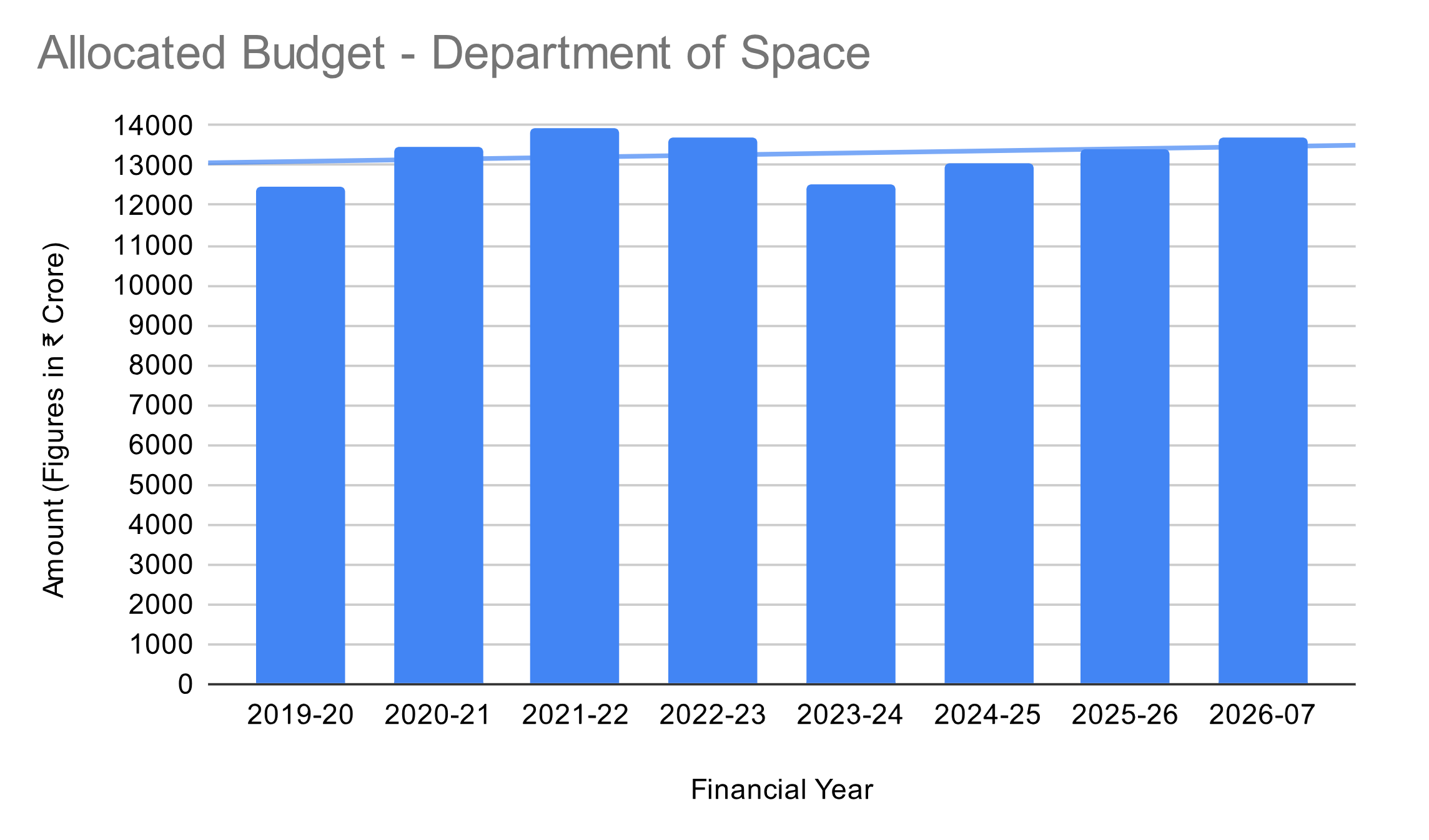
But the story becomes more interesting when you include the budgetary revisions that happen a year after the allocation. The revised budgets are always lower than the allocations.
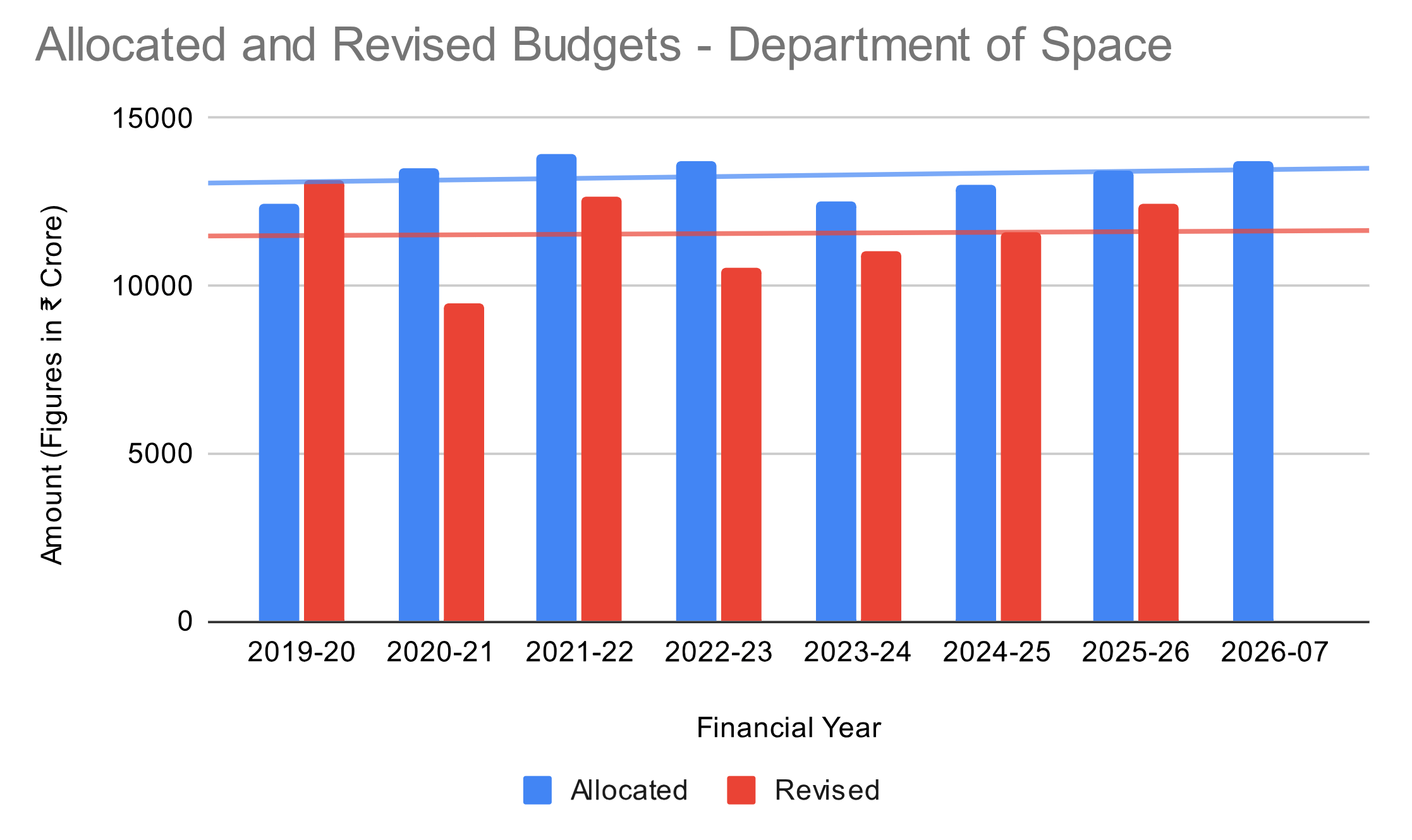
Adding the actual spending done by DoS/ISRO makes this even clearer. The department cannot seem to spend its budget fully.
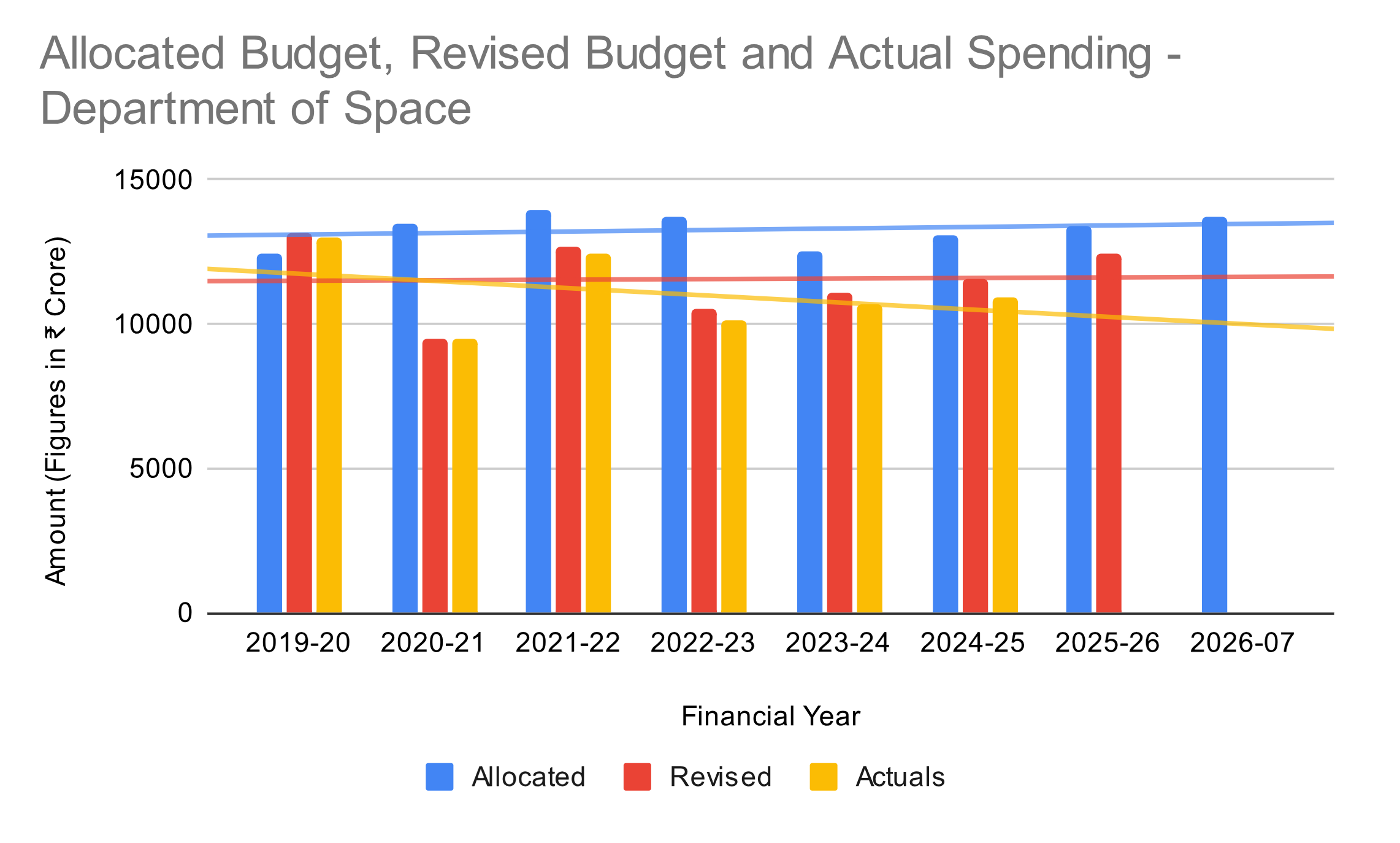
In fact, it has failed to utilise even the revised budget every year in the last seven years. Only in 2019–20 did DoS actually spend all of its allocation, likely because of Chandrayaan–2 mission peak costs. Since 2020, the total unspent amount by DoS totals more than ₹12,000 crore—effectively equal to one full year’s expenditure.
Breaking down the budget
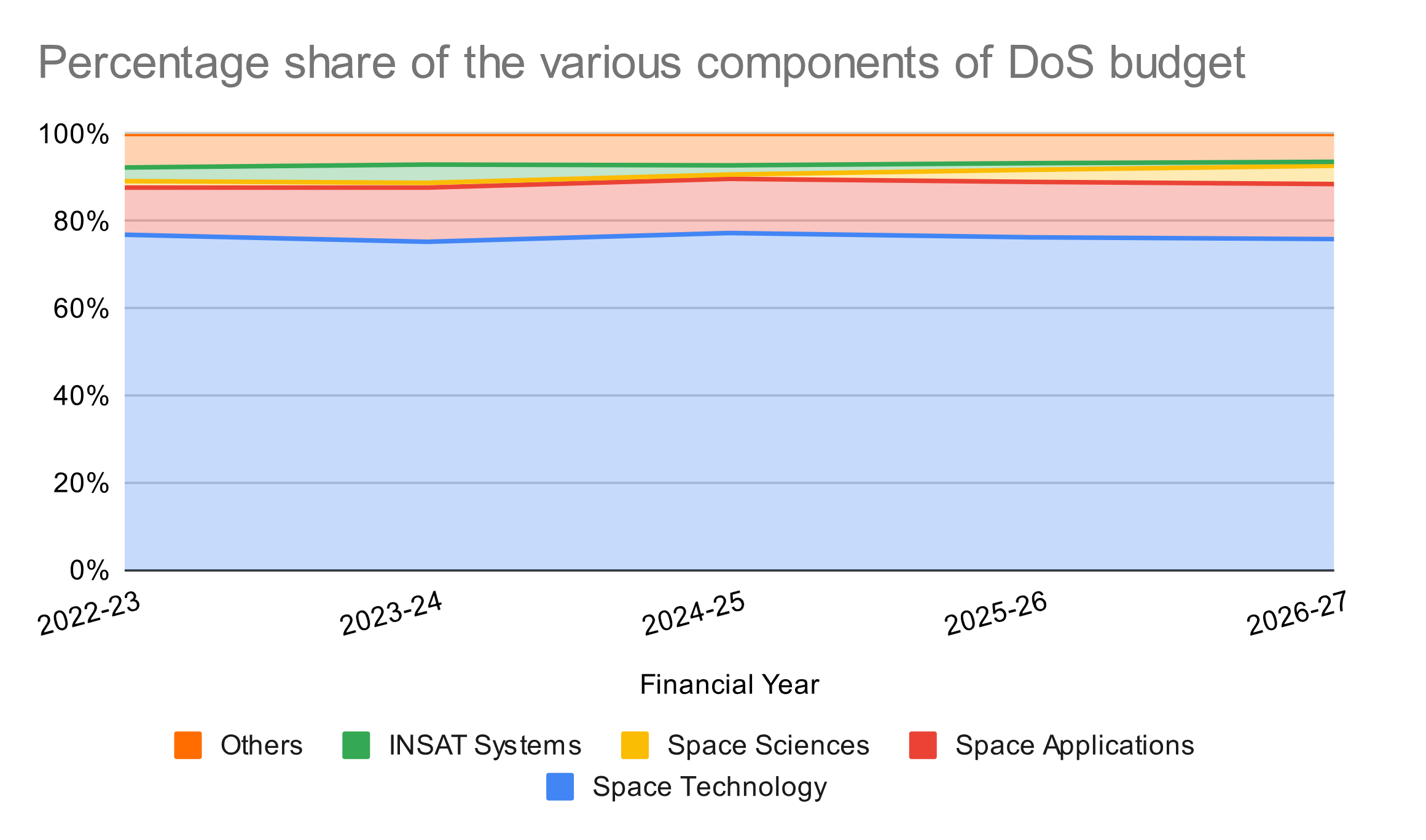
To try and understand these trends at a deeper level, we can look at the funding breakdown. Here is the breakdown for this year’s budget:
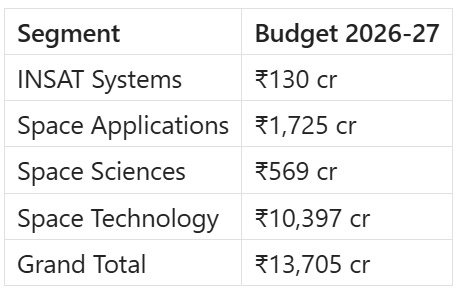
Let’s explore each segment one-by-one.
INSAT Systems segment
The INSAT Satellite Systems specifically funds communication satellites (like GSATs) that support TV broadcasting, telecommunications, and VSAT connectivity.
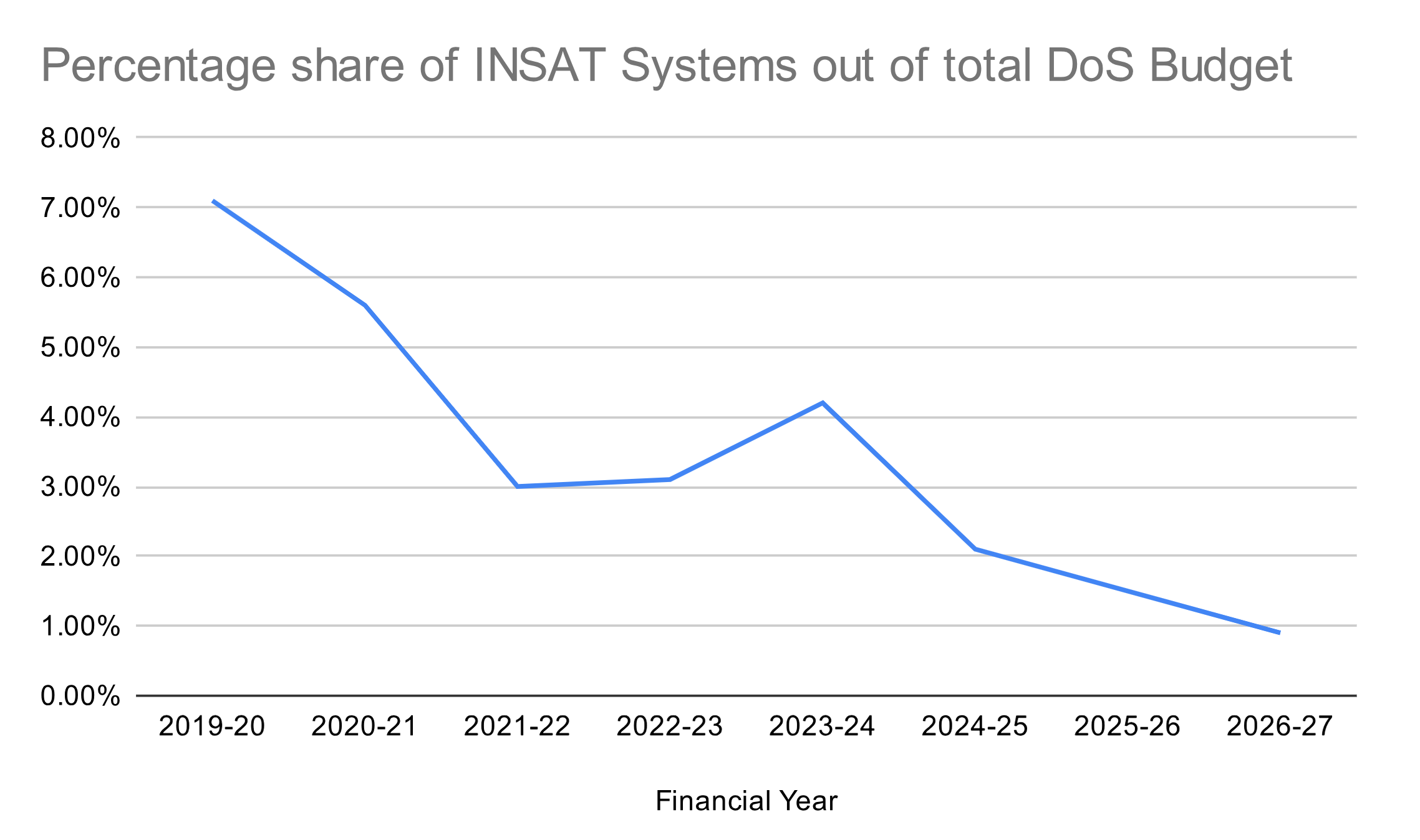
This year, with a mere ₹130 crore allocation, it makes for 0.9% of the total space budget. It is the least among the segments. A few years ago, this was not the case.
Even with absolute numbers, the INSAT budgets are falling.
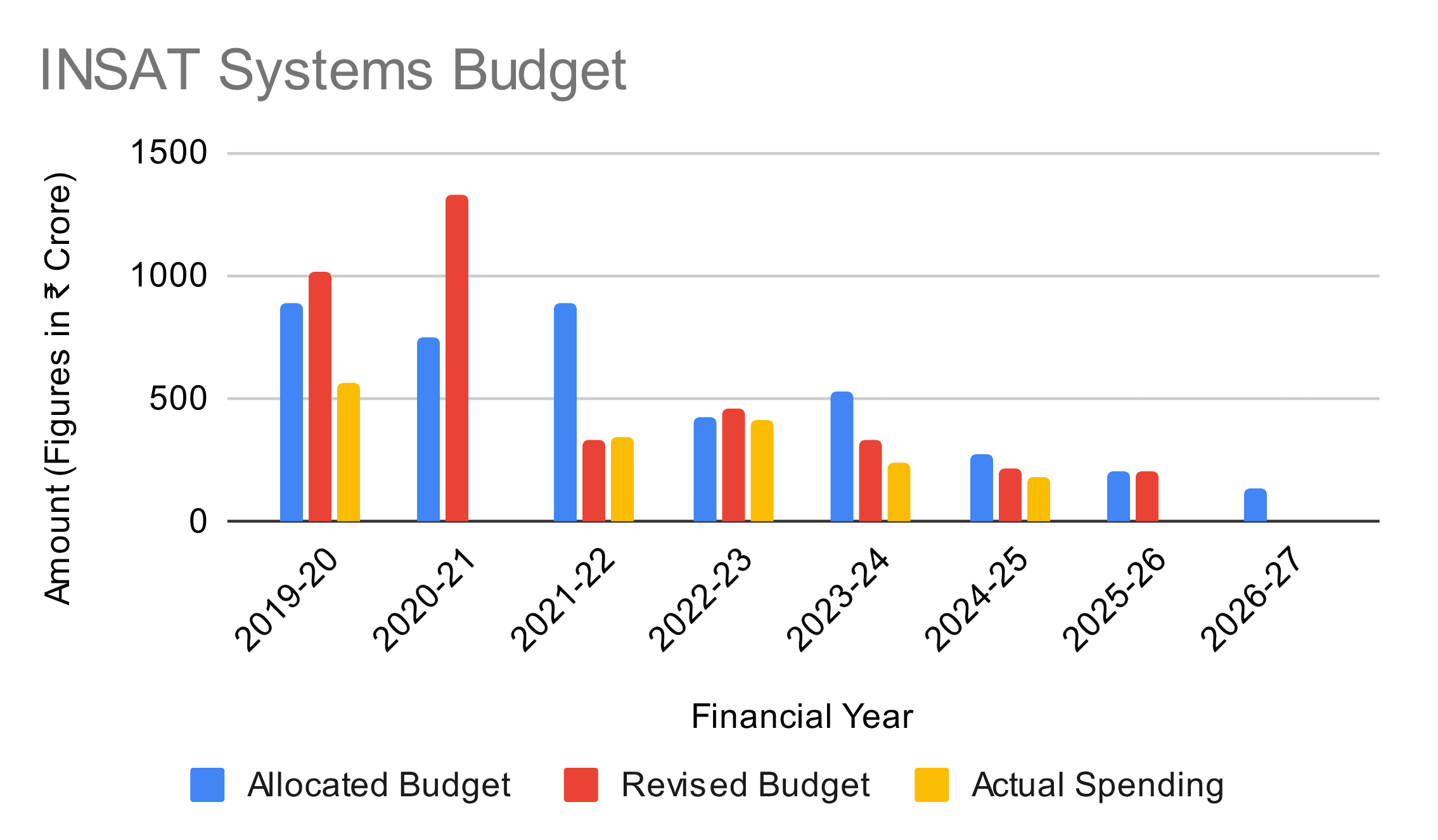
This is an intended trend. The government has been reforming the space sector since 2019. One of the reforms is to unburden ISRO of its routine tasks. The INSAT satellite systems fall within this basket. They are being transferred to NewSpace India Limited (NSIL), which will take over these operations. NSIL functions on a commercial logic. It will continue to fund them through its own internal resources or loans, based on demand. So systems like the INSAT may even grow in time but it will do so without direct taxpayer money.
Space Applications segment
Space Applications consists of making use of the data we get from ISRO satellites already in orbit. It is the downstream space sector. It includes things like remote sensing, disaster management support, agriculture, and urban planning using satellite imagery.
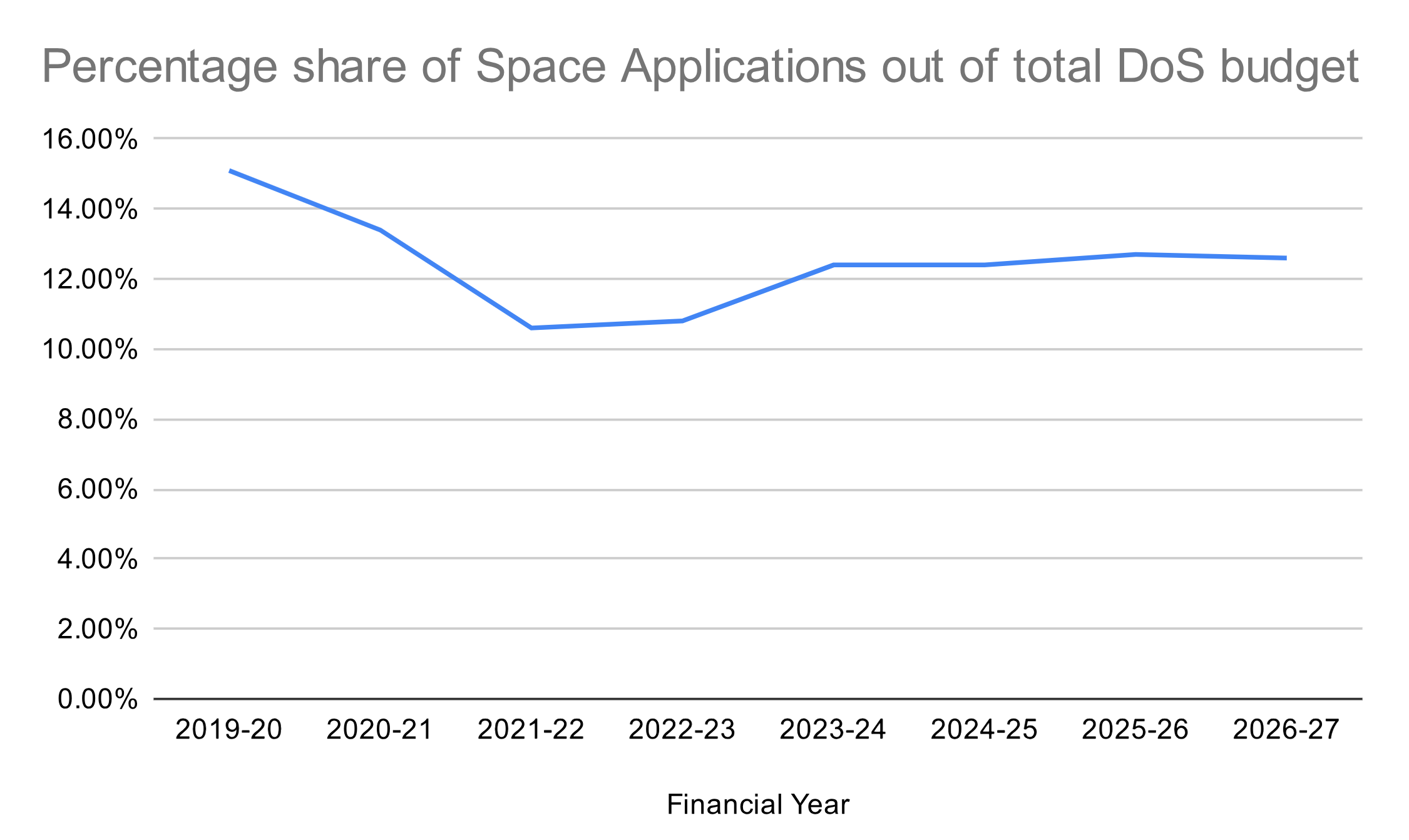
This segment has seen a stable but flat funding of around 13% of the total budget. The services are continuing but there is no big government-led expansion in the application infrastructure.
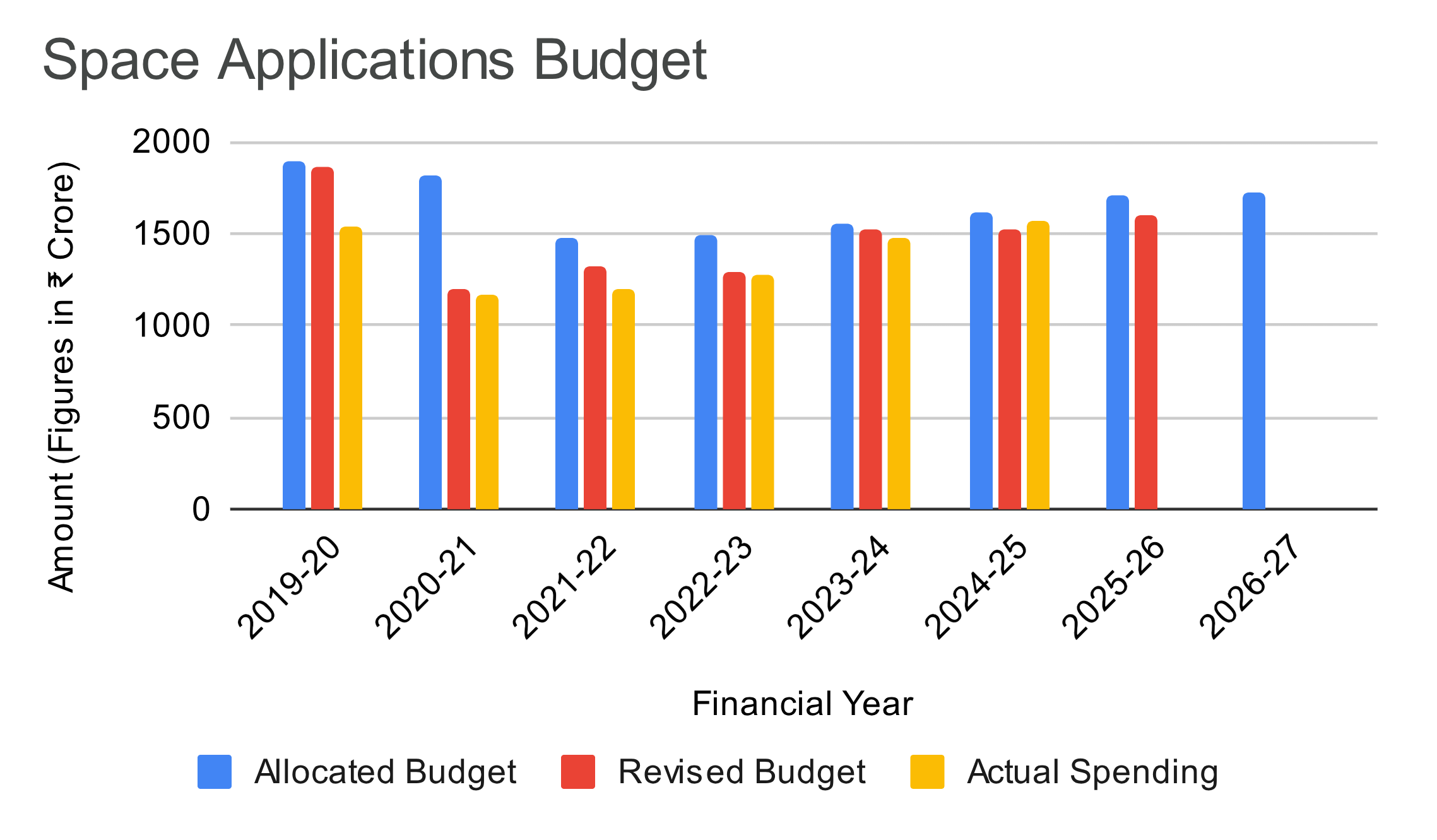
This segment operates like a service provider. 79% of its spending is revenue expenditure. Revenue expenditures fund the day-to-day operations. We can think of it as the ‘maintenance’ budget. It does not create assets or reduce debt like the capital expenditure does, which is harder.
Most of the space applications budget is used for running the National Remote Sensing Centre (NRSC) and Space Applications Centre (SAC), paying scientists, and maintaining the Bhuvan and Bhoonidhi data portals. The small share of capital allocation is for upgrading data centres and purchasing high-resolution data processing units. As a result, you see fuller utilisation of the allocated budgets every year. The revisions stay nearly the same.
The lack of growth here indicates that the government wants to focus more on other infrastructure creation activities. Private players are expected to take over application development in due course.
Space Sciences segment
Space Sciences is the exploration arm. It funds planetary missions like the Chandrayaan series, Aditya-L1, Venus Orbiter and astronomy. This is a priority sector for ISRO, under the new space policy. ISRO is being unburdened of INSAT and application-related responsibilities so that it can focus on space sciences and other strategic missions.
The government’s intent shows. It is the fastest-growing vertical in the 2026–27 budget. It has seen a 4x increase and occupies around 4% of the total budget. But this is still too low considering this is now a core function of ISRO.
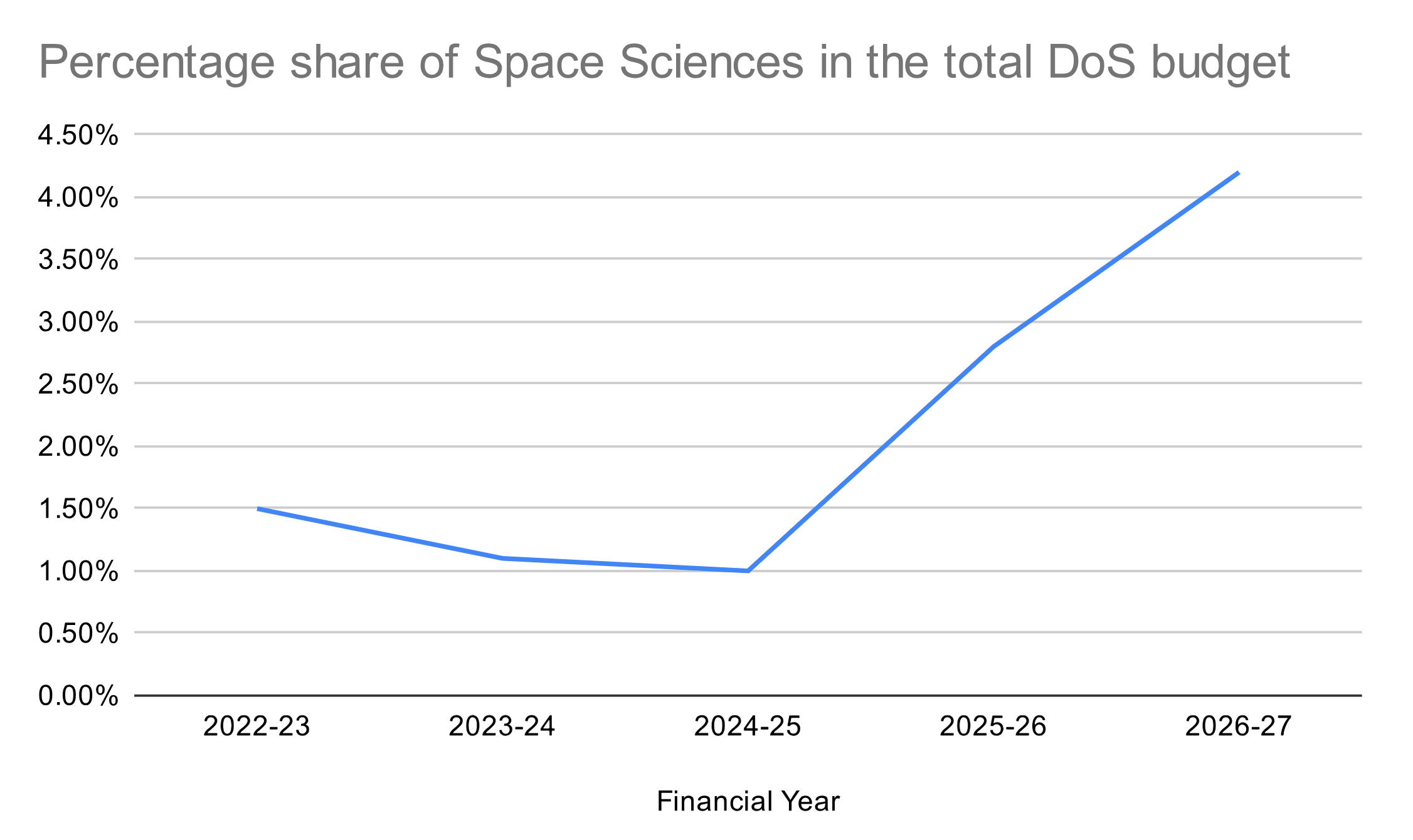
New project approvals for missions like Chandrayaan-4 and Shukrayaan are driving the increase in budget. Chandrayaan-4 aims to bring back moon rocks. Shukrayaan will be India’s first mission to orbit Venus. There are other projects on the horizon too like the Chandrayaan-5.
Space Sciences is a capital-heavy segment. 75% of the funds are for building hardware. Most of this year’s budget increase is for capital expenditure (from ₹98 crore revised budget in 2025–26 to ₹428 crore in allocated budget in 2026–27).
In 2025–26, the Department of Space projected a requirement of ₹876.14 crore for space sciences. However, the Government allocated only ₹371 crore. This year’s rebound to ₹569.76 crore could be because of last year’s cuts.
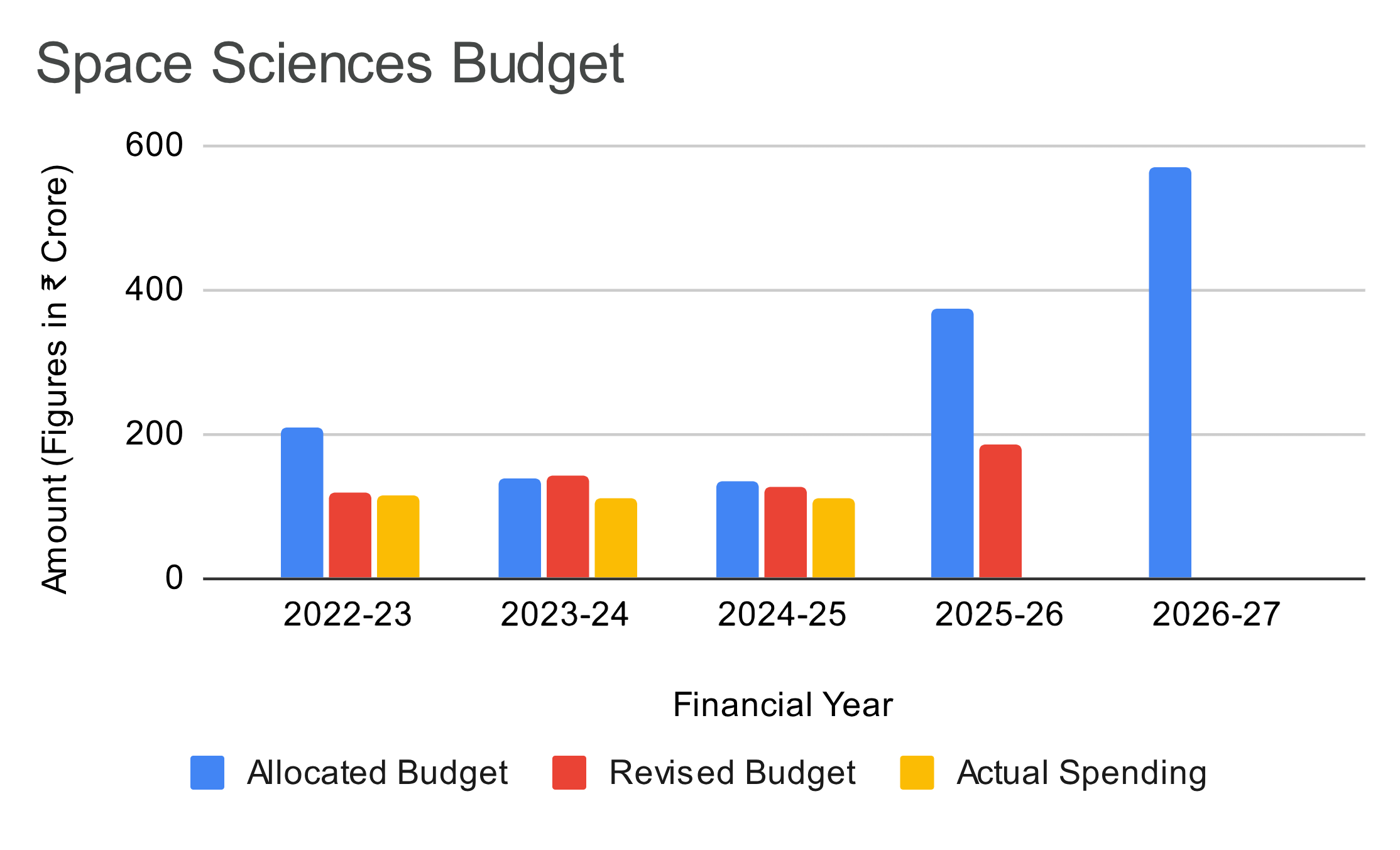
Despite the financial constraints, this segment has performed well. The successes of Chandrayaan-3, Aditya-L1, XPoSat and Astrosat highlight this. However, with actual spending consistently falling short of allocations, execution is lagging. Considering ISRO’s new mandate and the renewed global focus on lunar exploration, the spending here needs to increase.
Space Technology segment
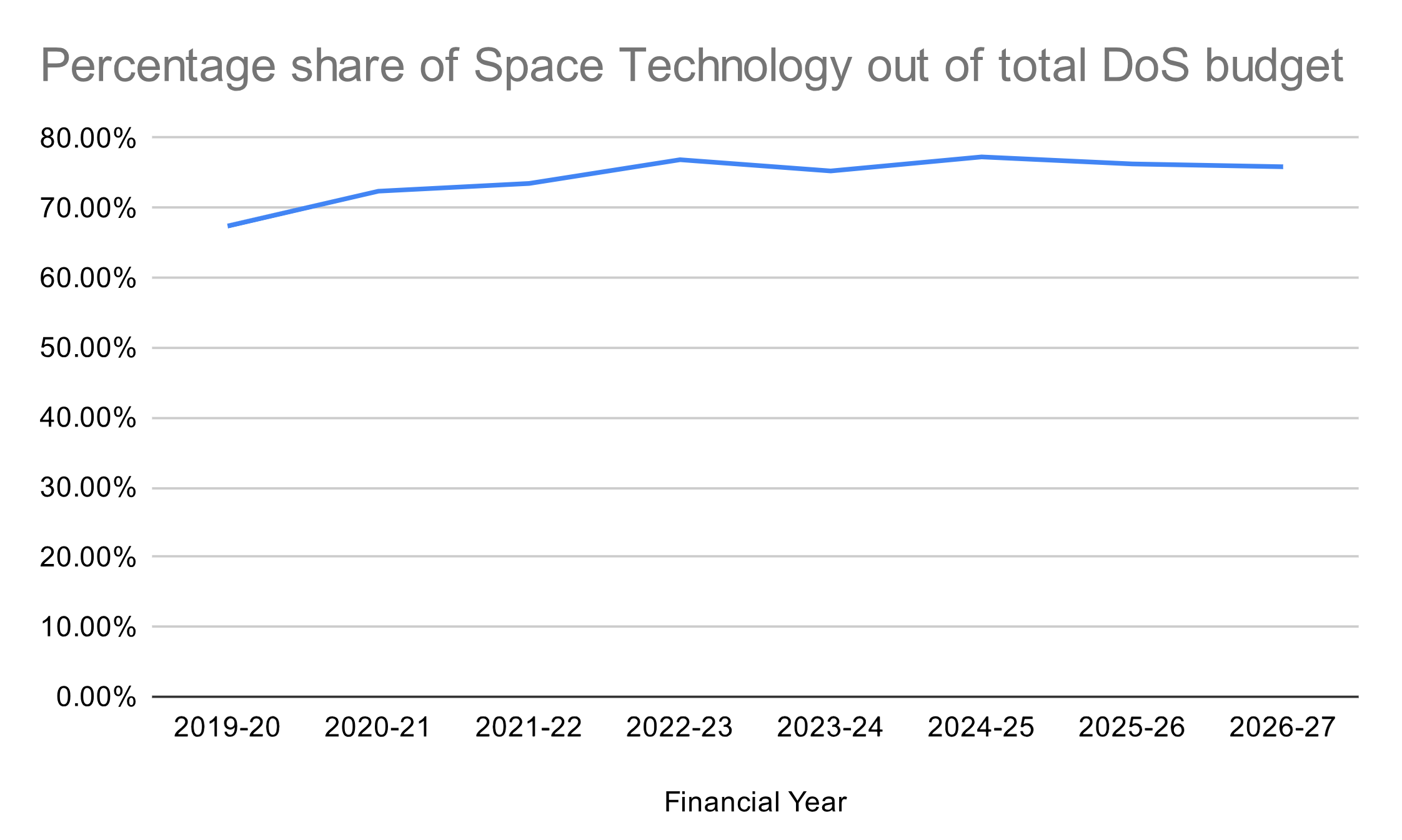
The Space Technology segment is the largest and the most critical component of ISRO. It consumes over 76% of the budget. It covers the heavy engineering and much of the core research activities that form the bedrock of India’s ability to access and participate in outer space.
The technology budget includes:
The development of launch vehicles. Launch vehicles are space rockets like LVM3, SSLV, PSLV and the upcoming NGLV.
The human spaceflight programme like the Gaganyaan mission and precursors to the Bharatiya Antariksh Station, which will be India’s first Space Station.
The development of Earth observation satellites like Oceansat and NISAR as well as navigational satellites for NavIC.
The infrastructure maintenance of ISRO centres like VSSC, LPSC, and the spaceport at Sriharikota (SDSC-SHAR).
Evidently, developing rockets and human spaceflight infrastructure remains with the government. This is in line with the new space policy as well. This part of the space technology infrastructure is foundational. It supports all the other space sector activities in the country. 2026–27 budget has a higher capital outlay of around 46.5% compared to the previous years where it hovered around 40% or lower. The Space Technology segment is the main driver of the capital increase. It is being used to build the third launchpad at Sriharikota, the cryogenic engine testing centre, human-rating facilities for Gaganyaan and NGLV. The revenue expenditures cover the fuel and operations for the rocket launches planned for the year.
The Space Technology component sees the most ambitious allocations but also the steepest cuts. It suggests that big-ticket hardware development (rockets/human rating systems) faces significant delays, leading to surrendered funds. The actual spending (and revised budgets) are consistently a lot lower than the allocated budgets.
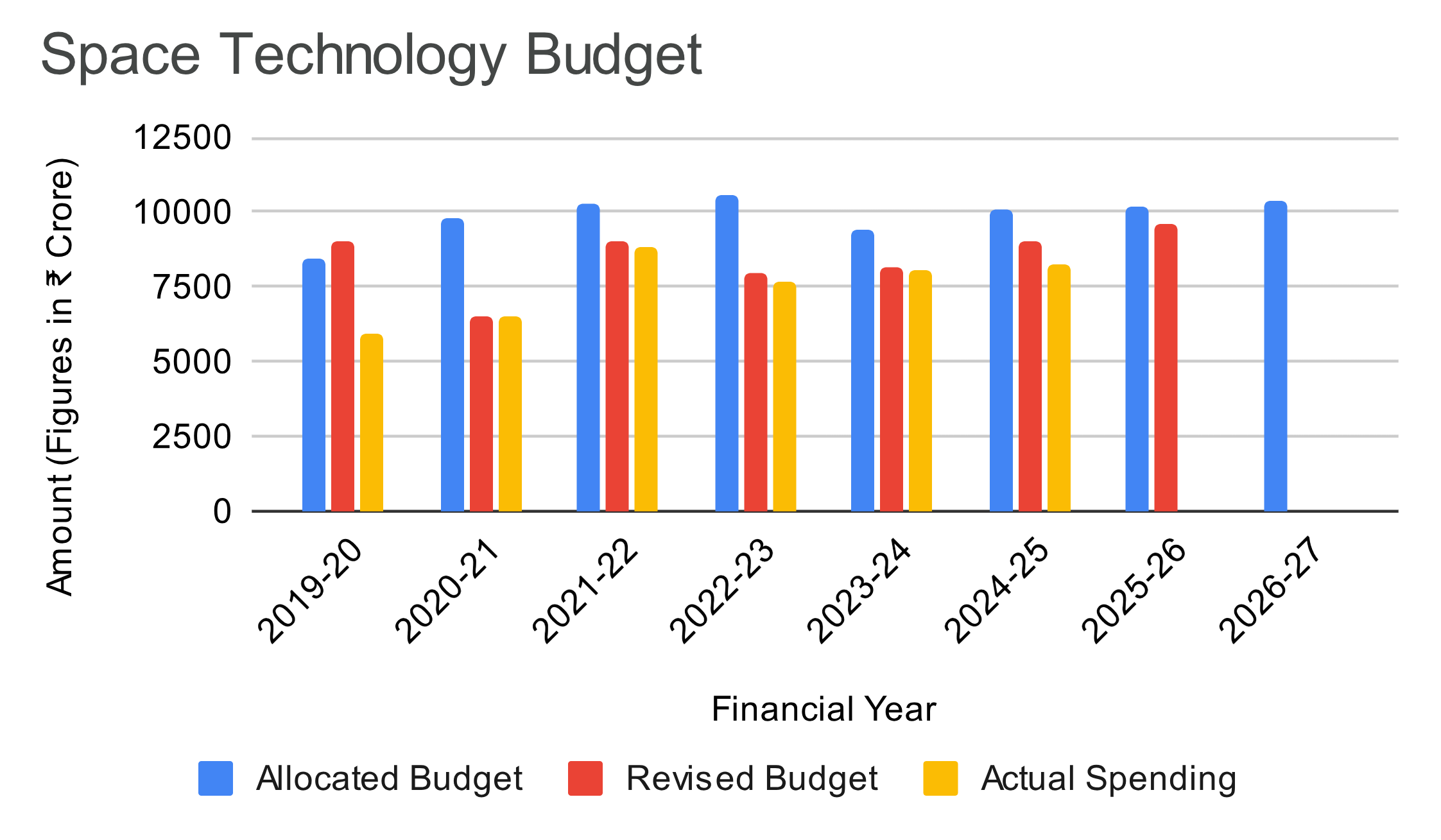
Slow pace of technology development has led the Finance Ministry to slash the budget at the revision stage for key projects. For instance, the Gaganyaan budget was cut from ₹1,200 crore (allocated) to ₹847 crore (revision) in 2024–25 due to delays in hardware realisation. The semi-cryogenic engine budget was cut from ₹190 crore to ₹115 crore. GSLV Phase-4 was cut by over ₹100 crore. So, this is a recurring pattern. Some of these delays are uncontrollable. There might be supply chain bottlenecks in international components. But the rest are controllable within ISRO and its vendors. The repeated mid-year cuts represent pauses in crucial R&D activities. It means a slowdown in indigenous innovation and delay in Indian space ambitions.
This is keeping in mind this segment’s successes that justify its high funding. The successful commercial deployment of 72 OneWeb satellites using LVM3; developing new capabilities like the SSLV to be transferred to the industry, the RLV (Re-usable Launch Vehicle) as a critical step towards reducing launch costs represent clear headway. There is the Gaganyaan progress also like the Test Vehicle (TV-D1) flight that demonstrated the Crew Escape System and the qualification of the LVM3 rocket for human rating.
India needs more government spending in Space
Drawing on Parliamentary Committee reports, I have added the ISRO projections below. The allocations are always lower than projections. This is not unique to space. There is always a gap between what the branches of the executive ask and what the Finance ministry can afford based on broader priorities and fiscal consolidation.
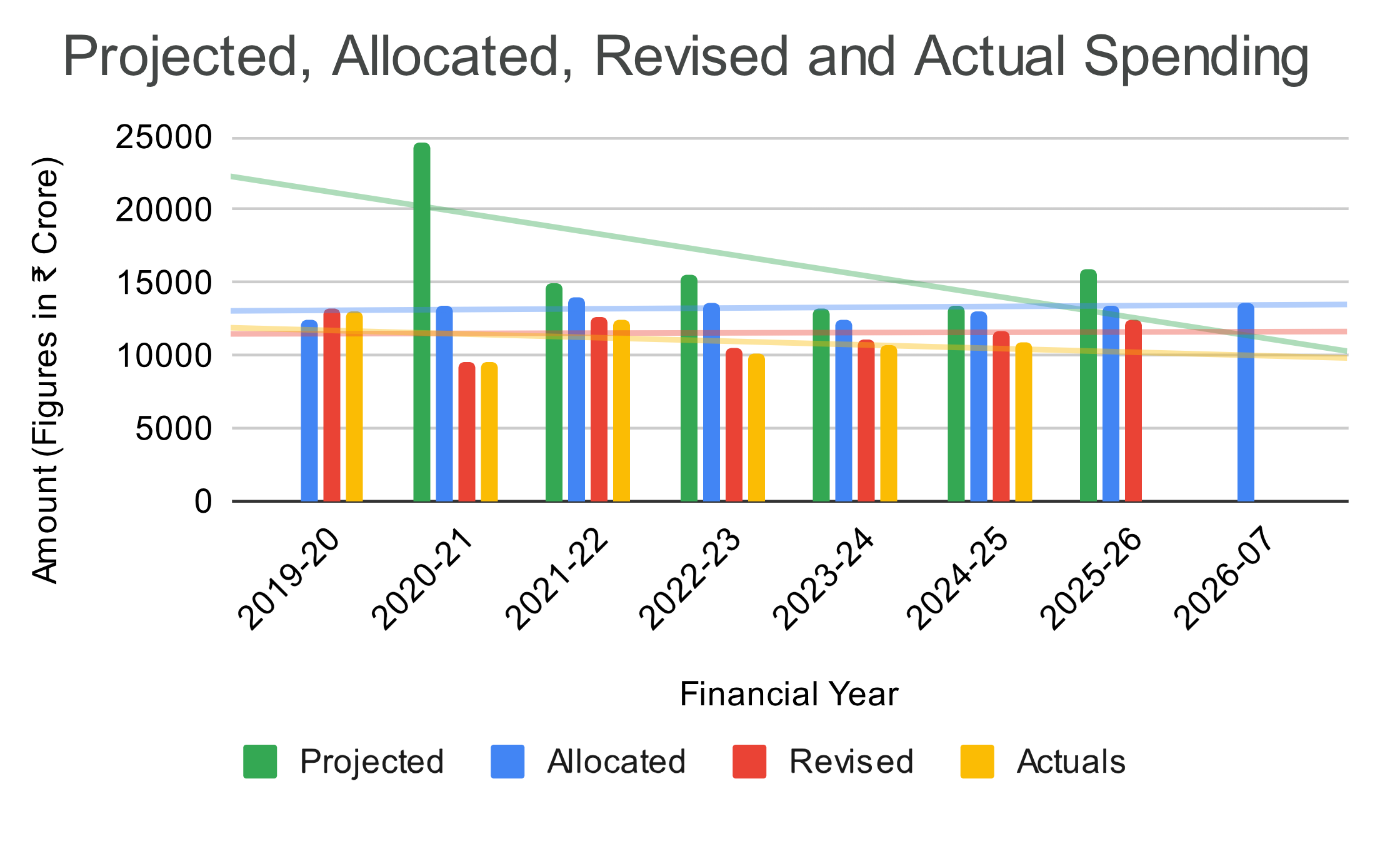
The most visible spike in projection was in 2020–21. ISRO projected ₹24,686 crore, probably because of Gaganyaan and Chandrayaan-3 development. The allocated budget was nearly half this amount. After all, it was the pandemic year. Since then, DoS seems to have rationalised its projections. The allocations are still lower but by much smaller margins. This indicates better alignment between ISRO’s planning and the Finance Ministry. But this does not mean the space programme is getting all the money it needs.
Indian space budget is ~0.05% of GDP. Other dominant space powers spend orders of magnitude higher than what India spends and this is not counting the commercial funding.
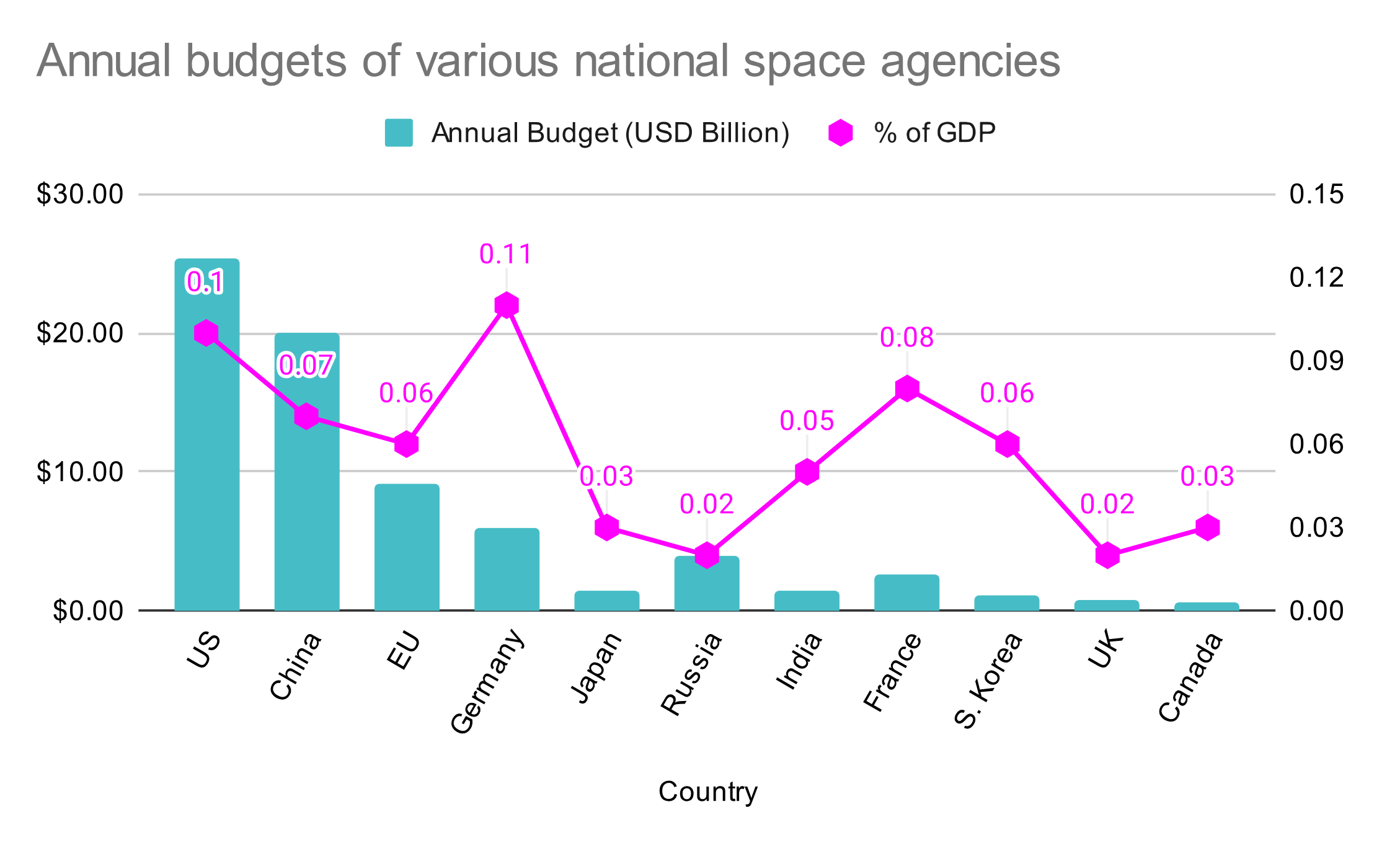
The previous ISRO chairman has said that the Indian space sector’s budget needs to be a lot higher. This is true. The private sector cannot do the things ISRO is tasked to perform. Planetary exploration, lunar missions, and human spaceflight aren’t just for scientific prestige. They come with geopolitical logic and are hard necessities for a space power today. Nations around the world have renewed focus and accelerated spending on their national space programmes in pursuit of these goals. If India fails to keep up in these technological races, it will have to bear political costs. It will lose its seat at the table that will decide the norms, rules, and benefit-sharing of humanity’s endeavours in space.
Bridging the gap between intent and outcomes
Another consistent trend we notice across all the segments and have already discussed is that the actual spending is significantly lower than allocations. Project delays are leading to unspent funds being returned. This high surrender ratio is pervasive within the broader category of scientific departments that includes space, biotechnology as well as science and technology.
This is a state capacity problem and not one of political will. The government has been consistent in allocating over ₹13,000 crore over the last few years. The political intent and support show. The leadership wishes and expects ISRO to achieve its objectives. The bottleneck is ISRO’s absorption capacity. This is particularly evident in ISRO’s capital expenditure. A large portion of the unused budgets often comes from the capital side which includes infrastructure, equipment and facilities—all critical for long-term growth. In fact, DoS’ surrender ratio is higher compared to sectors like Defence or Road Transport which also have capital-intensive activities. Those ministries have used their capital budgets more aggressively in recent years.
This issue can be addressed by positioning the government as an anchor customer for space technology. Not as an investor, not as a subsidiser, but as a customer. Since the new space policy has liberalised the sector, it is no longer a government monopoly. There are over 300 startups and traditional companies in the country alongside ISRO. Most are nascent with few avenues for funding and fewer avenues for early commercialisation. There is enormous scope for the government to act as a customer through service contracts with these companies.
The anchor customer model
An anchor customer relationship is where the government commits to buying services (launch, imagery, analytics) from a private firm at meaningful scale and over multiple years. This allows the firm to justify upfront capital expenditure and attract private capital. The secret ingredient that unlocks these things is the credible demand.
This is not entirely new to the Indian experience. The first instances of government acting as a customer in the space sector began with component contracts between ISRO and industry. Vendors supplied components and subsystems to ISRO’s missions. They were build-to-print contracts. ISRO designed everything. The private sector built it according to these specifications. ISRO absorbed all the risk as well as all the credit or blame. The vendor was rewarded for delivery and not for market success. They had no incentive to innovate on architecture, business model or other downstream services.
The more recent instance of the sector moving closer to anchor customer model comes from NSIL. The space reforms have positioned NSIL as ISRO’s commercial arm. ISRO has transferred the ownership of its Earth observation and communication satellites to NSIL. Other government ministries, foreign, and domestic customers approach NSIL for space technology services. NSIL provides these services by leveraging ISRO assets and by outsourcing the work to Indian industry whenever it can. For example, the Ministry of Defence is paying ₹3,000 crore to NSIL for the GSAT-7B communication satellite to fulfil the army’s needs. NSIL will pull in the industry to build and operate the asset. Another instance is NSIL using the HAL-L&T consortium to build PSLVs. This PPP model is structurally very close to an anchor-customer model, but not quite there yet. Because the demand is still not credible enough. It is coming from outside and can be inconsistent. For instance, foreign customers may prefer to launch via SpaceX over NSIL since SpaceX offers more reliable launch schedules or cheaper costs.
In a true anchor customer model, private firms design and own the satellites, launchers, analytics platforms and offer them as services to the government. Government buys outcomes, not ownership of hardware. If the government commits to a multi-year off-take, it will have de-risked capital expenditure, and the private firm will attract private equity or debt that it otherwise would not be able to. At the end of it, the firms will own their IP and can go on to export the same service globally. Many globally successful space companies like SpaceX, AWS, and Northrop Grumman emerged from this model.
India is already in the early stages of doing this systematically. There is currently an Earth observation-PPP project where a consortium of companies are investing over ₹1,200 crore to design, build, own and operate a constellation of satellites (government as an anchor customer de-risking capital expenditure). They will use this asset to sell imagery and analytics to government and armed forces in India. Though they call it a PPP, this is functionally the government acting as an anchor customer for EO services. In another instance, the Telangana government has signed a contract with a private company to digitise farmlands to replace manual crop surveys. As a result, these companies have attracted new private investment (government as an anchor customer unlocking private investment).
Clearly, the anchor customer model is taking shape in the country. But the instances are few and far between. Government should fund more contracted service payments to Indian firms that can grow and add to India’s space prowess.