


The Orrery is a fortnightly newsletter on space power and policy, written from an Indian seat. Each edition examines a consequential development in space. This October was a quiet spell for the Orrery owing to the festive season. I regret the delay. Thank you for bearing with it.
A young Ukrainian artilleryman, callsign Ukrlan, hunkers down in a bunker in Donbas. He is on the active front line of the Russia-Ukraine war.
The constant shadow of attack drones has led to this region being called the “kill zone”. The drones hunt anything that moves—whether a tank, a supply truck, a soldier. Even resupplies arrive on heavy drones that drop food, water, medicine and ammunition directly into bunker openings. Most drone operations as well as communication with HQ run on Starlink.
When his unit’s Starlink connection deteriorated in October, Ukrlan felt the loss immediately.1
On one hand, foreign satellite internet services like Starlink offer enormous benefits the user states. Their reach extends to almost all of the Earth—across mountains, islands, forests and deserts. They reduces the need to build fibre or mobile towers when ground infrastructure is absent or damaged. This immediately makes its usefulness obvious to remote villages, hospitals, open seas and disaster-struck regions.
More strategically, it has tremendous military value, as observed in Ukraine. For more than four years, Ukraine has depended on Starlink to connect soldiers, headquarters, reconnaissance systems and drones.2
On the other hand, counting solely on a foreign satellite internet service carries the risk of essential national communications lying beyond sovereign control.
Recent reporting reveals that successive US administrations have asked SpaceX to activate or restrict Starlink connectivity in countries including Ukraine, Iran, Lebanon and Yemen.3
This edition is meant to serve as an instruction manual for states as they navigate decisions about whether, where, and how to adopt foreign satellite internet networks.
The control problem
Satellite internet megaconstellations like Starlink concentrate control with their operator—and, by extension, the provider state. Satellites pass overhead, indifferent to national borders and tricky terrain.
User terminals that connect to the satellites work only if the operator authorises them. The operator can also block users, draw geographical limits and change the conditions under which a connection works.
Conversely, user states have little control. They can use licensing to impose rules, monitor some aspects of the service and penalise violations. But that does not necessarily give the user states the technical ability to operate the network or independently reverse a restriction.
Two problems follow: an operator may serve users despite a user government’s objection, or restrict a service on which the user government has come to rely.4
Case Study 1: Ukraine—Dependence on continued service
In 2022, Russian cruise and ballistic missiles as well as self-detonating Shahed drones targeted Ukrainian telecom infrastructure. They were successful in damaging Ukraine’s traditional, centralised communication networks. This created an immediate, existential void that a decentralised, satellite-based system like Starlink was well-suited to fill.
Soon, Starlink became one of the backbones of Ukraine’s wartime communication. It was used for live battlefield coordination, streaming reconnaissance video and powering drone warfare.
By mid-October 2026, fast-moving military drones started losing Starlink connectivity above roughly 160 km/h. There was no advance warning. The speed restriction hobbled the Ukrainian interceptor drones. They could no longer pursue the fast Russian attack drones. It also disrupted other frontline counteroffensives and resupplies.
The speed limits seemed to be regionally limited to Ukraine. Starlink worked fine even at speeds above 180 km/h in other EU countries, according to Ukrainian tests.5
These disruptions came amid a dispute between the US and Ukraine over negotiations with Russia. The US wanted Ukraine to stop its strikes on Russian refineries. Ukraine was unwilling to do so when the Starlink restrictions hit.
Some reports indicate Elon Musk ordered the restrictions, while others claim that the White House did. Eventually, Musk himself acknowledged the restrictions on Starlink.6
By the end of October, the restrictions were gone and Starlink was working again. Even at 400 km/h. To resolve the disruption, Ukraine had engaged SpaceX and US officials. However, new reports from mid-November say the restrictions have returned again.7
The lesson for states from this debacle is: Ukraine could not independently prevent or reverse changes to a service on which its military relied.
Case Study 2: Iran—Unwanted availability
The situation in Iran was the mirror image of the Ukraine crisis. Starlink was active in Iran without national authorisation. In its quest to stop Starlink use within its territory, the Iranian government could only do so much to locate or block every Starlink connection.
Unable to do much else, Iran went to the International Telecommunication Union (ITU). The ITU’s Radio Regulations Board recorded repeated Iranian complaints and continued unauthorised Starlink activity. It also noted evidence of Starlink’s ability to locate and remotely turn off connections. But none of these proceedings led to Starlink complying.8
The lesson here is: despite having the legal rights and the ITU taking positions in its favour, Iran could not prevent the unauthorised service from operating on its soil.
Case Study 3: Ukraine and Russia—Successful cooperation with SpaceX
In February 2026, Russian forces were using illicit Starlink terminals on drones. Ukraine and SpaceX introduced an allowlist so verified Ukrainian terminals could remain connected while Russian terminals were blocked.9
The same satellites were overhead. Access on the ground was made selective.
The lesson here is: foreign operational control actually helped a user state’s interests. But does a successful cooperation today guarantee the terms of access tomorrow?
New technology, new capabilities, new challenges
From September 2021, Starlink satellites included optical inter-satellite laser links. These were beams of laser light travelling through the vacuum of space, carrying data from one satellite to another.
Without laser links, satellites relied on ground stations within radio range. This created physical points on the surface where states could exercise control. Laser links weakened that point of control for user states.
A recent expansion of its direct-to-cell service, called Starlink Mobile, is also extending connectivity directly to compatible ordinary phones, through participating mobile operators. It will widen the range of users and activities that depend on satellite service.10
The hidden price of dependence
Foreign satellite internet services like Starlink may provide better service at lower cost than domestic alternatives. Consumers benefit from coverage, choice and competitive prices. Denying them that choice or forcing them onto inferior services imposes real costs on households and businesses.
But there is a hidden price to cheap foreign connectivity.
Foreign satellite networks can discourage domestic alternatives. Satellite internet networks need enormous upfront capital and frequent launches. Established foreign providers like Starlink enjoy economies of scale across many markets. A domestic entrant may struggle to justify investment against a mature imported service. If that prevents the development of independently usable capacity, a country and its consumers may find themselves completely dependent on a foreign service, which may well be used as a tool of foreign coercion.
Ideally, a country would have its own globally competitive alternative. A more realistic option is a smaller network designed around essential government and military needs, perhaps selling spare capacity commercially.
Government procurement can help finance such infrastructure. In August 2026, Canada awarded Telesat a C$2.3 billion military communications contract that will fund an expansion of its planned Lightspeed constellation from 156 to 225 satellites. The added satellites will carry both military and commercial capacity.11
Not every state can afford even that. Nor does every state need independent control of every connection. So states should decide their satellite internet policy based on how much assurance they need that their communication systems will remain usable when needed most.
The three degrees of assurance
A user state cannot set the same degree of assurance as a requirement for the entire country. Different missions have different stakes and warrant different arrangements. Civilian and military uses also cannot be neatly separated since they may use the same infrastructure.
Consider a police station in a remote region. It may use the same satellite connection for managing daily administrative filings, coordinating disaster relief convoys and monitoring remote border outposts.
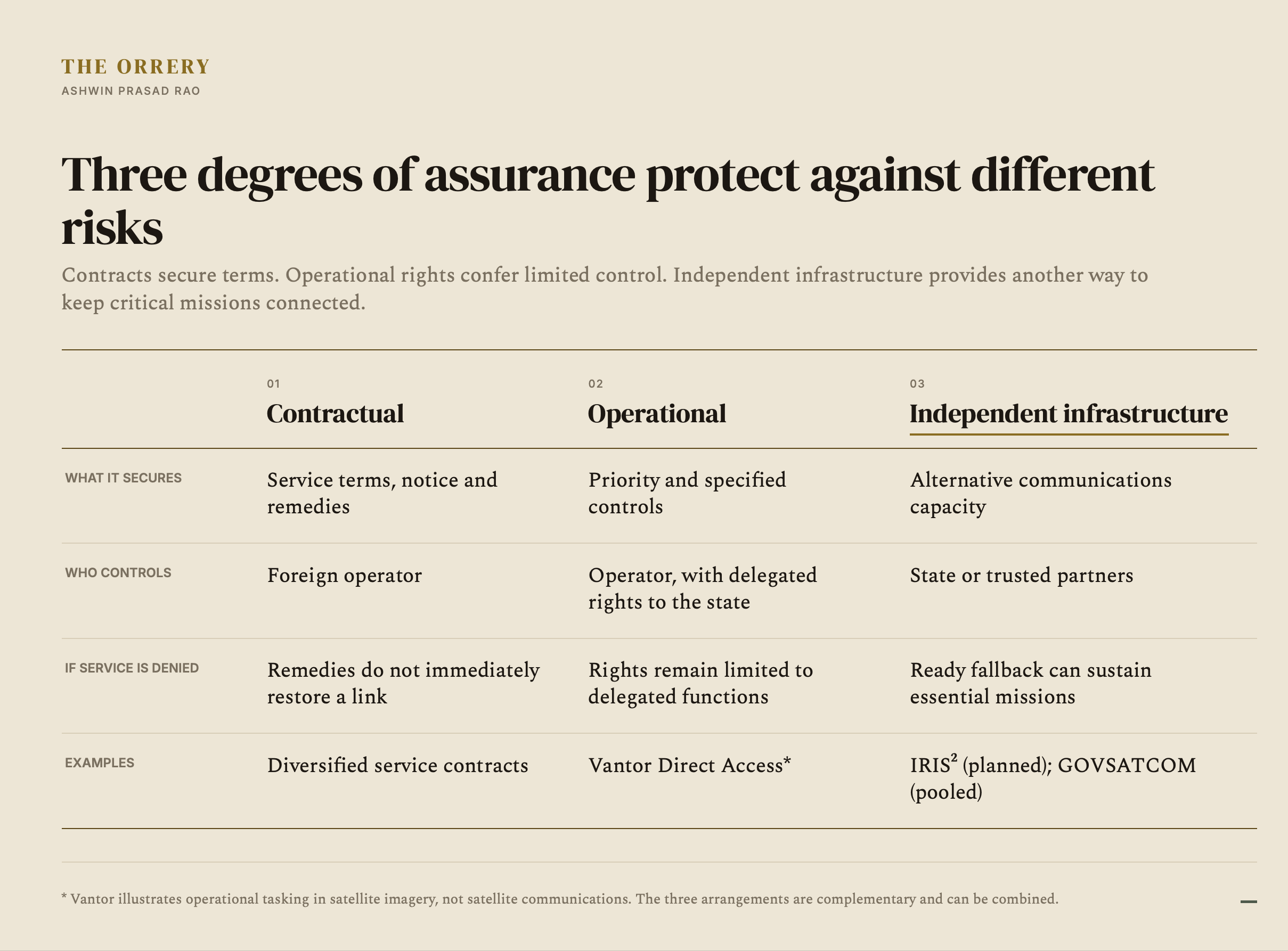
User states can design their policy around three degrees of assurance: contractual, operational and independent infrastructure. They can weave these mechanisms together to fashion a policy pattern that fits their priorities.
01. Contractual assurance
User states can leverage market access to secure coverage, bandwidth, performance and priority for critical needs. These guarantees can include financial penalties if the terms are broken. Such agreements are a cost-effective option for user states.
But the foreign operator retains most of the technical control. A contract or a penalty does little to address a failed connection in the middle of a military operation.
Some of the risk can be mitigated through diversification. Instead of licensing or purchasing from Starlink alone, a user state can buy service from diverse operators across different provider states.
It will take some work on the part of the user states to prevent a lock-in to a single service. They will have to invest in redundant equipment and ground support. And the user states have to institutionalise this interoperability at the planning stage.
Doing this during ongoing military operations is moot. See the recent events in Ukraine. European alternatives could not immediately replace Starlink when it was restricted.12
While shopping for diversification, user states should pay attention to the rules of the provider state’s domestic policies. Following the Ukraine restrictions, US lawmakers asked who should authorise changes to critical services supplied to allies and what warning those allies should receive. Clayton Swope, Lauryn Williams and Alexei Hoffman at CSIS have proposed stronger US review and notification arrangements.13
02. Operational assurance
The second degree of assurance around operations gives user states direct control over key network functions: authorising users, restricting service during emergencies, and prioritising traffic.
The private company continues to build and run the infrastructure. The user state has the ability to assert its operational priorities. This assurance needs more than mere promises.
The blueprint is already visible in other commercial space services. Vantor’s Direct Access programme lets customers task its imaging satellites and receive data through their own ground facilities—without owning the infrastructure. It is an imagery service, not satellite communication. But it shows how a foreign commercial operator can hand over the controls for key tasks.14
03. Independent infrastructure
The third degree of assurance via independent infrastructure shoots for fuller autonomy. Some states may find themselves frequently involved in missions with monumental stakes. The cost of foreign dependence and the ensuing risk of denial may be too great to bear.
Such user states may find it worthwhile to develop their own constellation; or procure one operated under its control; or even build a jointly governed network with trusted partners. The objective is to realise an alternative system that can continue operating even during foreign denial.
Europe’s IRIS² is a good example of this. It combines commercial development with EU ownership and priority rights for state uses. In the meantime, the EU’s GOVSATCOM pools satellite communications capacity from five member states. Cyprus—despite owning none of the satellites—used the shared system in March 2026.15
There can never be absolute autonomy. But a high level of autonomy is realistic—something which allows them to preserve coverage, bandwidth and network-management authority for essential functions—even if it does not reproduce Starlink’s global reach.
After the October experience, Ukraine itself signed a letter of intent with ICEYE and Nokia to explore sovereign satellite communications.16
Building and maintaining such an independent infrastructure is no mean feat. It demands huge costs of deployment, maintenance and replenishment of spacecraft. It may still rely on imported components or foreign launch services.
India and its choice
India has good reasons to adopt foreign satellite services for civilian connectivity. It also has reasons to realise high assurance levels for sensitive government and military functions.
India’s satellite communications rules are an attempt at contractual assurances around domestic gateways and monitoring conditions. But these seemed to be aimed at monitoring and restricting satellite connectivity rather than maintaining availability during crises.17 To me, this betrays the instincts of an inward-looking state preoccupied with policing connectivity rather than an outward-looking one focused on guaranteeing it.
India cannot assume it can prevent every unauthorised terminal from operating. That should especially not serve as a distraction from the harder task of securing its own essential communications. That realisation will immediately highlight the importance of expanding land-based internet.
As far as satellite internet is concerned, India can assess assurance mission by mission, procure independent infrastructure where failure would be unacceptable and diversify with alternative providers where that is practical.
Procurement orders could also provide a fillip to demand for domestic satellite manufacturing, launch and related industries—something the Indian government is already pursuing.
No one size fits all. Every user state has to find its answer rooted in its threats, budgets, and capabilities. Ultimately, the question that each state has to ask itself is: can it keep its essential communications running when an outside decision—or a technical failure—takes away the service it expected?
A new edition of The Orrery is published every fortnight. Ashwin Prasad Rao is Staff Research Analyst at the Advanced Military Technologies and Outer Space programme at the Takshashila Institution. The Orrery is personally owned and written; the views are his own.
The opening scene is a creative reconstruction based on reported details from Sergiy Chalyi, “Starlink disruptions are being felt on the front lines of Ukraine”, Reuters, 16 October 2026.
Clayton Swope, Lauryn Williams, and Alexei Hoffman, “Who Controls Ukraine’s Starlink Access?”, Center for Strategic and International Studies, 2 November 2026.
Erin Banco and Joey Roulette, “US has for years asked Musk to alter Starlink service in Ukraine, Middle East, sources say”, Reuters, 24 October 2026.
International Telecommunication Union, “Provision of Starlink satellite services in the territory of the Islamic Republic of Iran”, Radio Regulations Board proceedings, 2023–2026; Clayton Swope, Lauryn Williams, and Alexei Hoffman, “Who Controls Ukraine’s Starlink Access?”, Center for Strategic and International Studies, 2 November 2026.
The restriction centred around Starshield, the military service used alongside Starlink; Clayton Swope, Lauryn Williams, and Alexei Hoffman, “Who Controls Ukraine’s Starlink Access?”, Center for Strategic and International Studies, 2 November 2026; Interfax-Ukraine, “Ukraine has confirmation Starlink speed restrictions apply only within its territory – Zelenskyy”, 17 October 2026.
Alexander Ward, Natalie Andrews, and Josh Dawsey, “Musk Ordered Starlink Slowdown That Blindsided Ukraine”, The Wall Street Journal, 20 October 2026; Gram Slattery, “Starlink access in Ukraine a decision for Musk, not White House, Rubio says”, Reuters, 21 October 2026; Clayton Swope, Lauryn Williams, and Alexei Hoffman, “Who Controls Ukraine’s Starlink Access?”, Center for Strategic and International Studies, 2 November 2026.
Ministry of Defence of Ukraine, “Starlink and Starshield speed restored in Ukraine”, 24 October 2026; Office of the President of Ukraine, “Starlink and Starshield Operations Have Been Restored to the Speeds We Had Before All the Restrictions”, 24 October 2026; Yuliia Dysa, “Ukraine says Starshield back to normal, Musk says Kyiv violated terms”, Reuters, 24 October 2026; Olena Harmash, Ukraine’s Zelenskiy escalates criticism of SpaceX over speed caps, Reuters, 14 November 2026.
International Telecommunication Union, “Provision of Starlink satellite services in the territory of the Islamic Republic of Iran”, Radio Regulations Board, 94th–103rd meetings, 2023–2026.
Ministry of Defence of Ukraine, “Ukraine rolls out Starlink terminal verification to counter russian aerial terror”, 2 February 2026; Ministry of Defence of Ukraine, “Starlink terminals on the whitelist remain operational, while russian terminals have already been blocked”, 5 February 2026.
Ashwin Prasad Rao, Aditya Ramanathan, and Col. Das (Retd.), “Starlink and Risks for India”, Takshashila Discussion Document 2026-12, 12 April 2026; Starlink, “Starlink Mobile”, n.d.
Telesat, “Telesat secures $2.3 billion Arctic military satcom contract, expanding Telesat Lightspeed network and capacity by 44%”, 4 August 2026; Defence Investment Agency, Government of Canada, “The Government of Canada awards a military communications contract to support Arctic sovereignty and national security”, 4 August 2026.
Vaishnavi Hajari, Gianluca Lo Nostro, and Cassell Bryan-Low, “Can Europe step in as Ukraine struggles with Starlink and US satellite data?”, Reuters, 14 October 2026; Clayton Swope, Lauryn Williams, and Alexei Hoffman, “Who Controls Ukraine’s Starlink Access?”, Center for Strategic and International Studies, 2 November 2026.
Richard Blumenthal, “Blumenthal Announces Congressional Inquiry into Starlink & Starshield”, United States Senate, 22 October 2026; Clayton Swope, Lauryn Williams, and Alexei Hoffman, “Who Controls Ukraine’s Starlink Access?”, Center for Strategic and International Studies, 2 November 2026.
Vantor, “WorldView Access Programs”, n.d.
European Parliament and Council of the European Union, “Regulation (EU) 2023/588 establishing the Union Secure Connectivity Programme”, 15 March 2023, Article 6; European Union Agency for the Space Programme, “Cyprus Completes First Operational Use of EU GOVSATCOM HUB Services”, 10 March 2026.
ICEYE and Nokia, “ICEYE and Nokia partner with the Ministry of Defence of Ukraine to develop sovereign satcom capability”, 22 October 2026.
Department of Telecommunications, Government of India, “Telecommunications (Authorisation for Provision of Principal Telecommunication Services) Rules, 2026”, Gazette of India, 23 June 2026, Chapter VII, rules 58–60; Ashwin Prasad Rao, Aditya Ramanathan, and Col. Das (Retd.), “Starlink and Risks for India”, Takshashila Discussion Document 2026-12, 12 April 2026.