


Colonial Exploitation
On the western coast of the Indian subcontinent, by the river Tapi, lies the city of Surat. In the 17th C, Surat was a bustling port, teeming with artisans, traders and sailors. Hailed as a cosmopolitan emporium of the Indian empire, its docks were littered with Indian, Chinese, Persian and Southeast Asian ships.1 Through the 18th C, however, Surat was in a state of decline. By 19th C, it had become a languid coastal town with a population of a mere 80,000 people.2
Surat wasn’t the only Indian city to undergo de-urbanisation. Prominent urban centres like Machilipatnam, Srirangapatna and many others also couldn’t endure the colonial era. The economic policies of the British impoverished the Indian society. They created and sustained a de-industrialised and de-urbanised economy - rebuffing all the economic and social benefits that come with it. The result was a largely rural, agricultural, impoverished society with deep economic and social inequalities.
While striving for self-rule, the leaders of the Indian independence movement had to garner the support of the masses. They assured the people that the end of the British rule would be the end of their woes. The people recognised that it was the State that created the terrible socioeconomic conditions, that the State had to undo these conditions for things to improve. Consequently, the public’s thoughts went a step beyond - the idea that the State itself had to create better socioeconomic outcomes took hold. A tendency to lean on the State had developed already. When independence came on 15th August 1947, it came with a lot of hope and expectations. However, the promises made were too great.
Ideological Winds
Every nation, at its birth, is shaped by its founding political leaders. And those political leaders are shaped by the prevailing ideological winds of their time. Thinkers like John Locke dominated the ideological moorings of the American founding fathers. His liberal ideas of strong individual freedom and property rights find a direct mention in the US Declaration of Independence.
On the other hand, some of the most influential voices during and after the Indian Independence struggle were socialists. The Indian leaders were educated in the era of Marxian thought and the Russian revolution while being under the repressive colonial clasps of a liberal nation. It is no surprise that Socialism appealed to them. Socialist thought emphasised the equality of outcomes rather than opportunity. It lay the responsibility of ensuring this with the State.
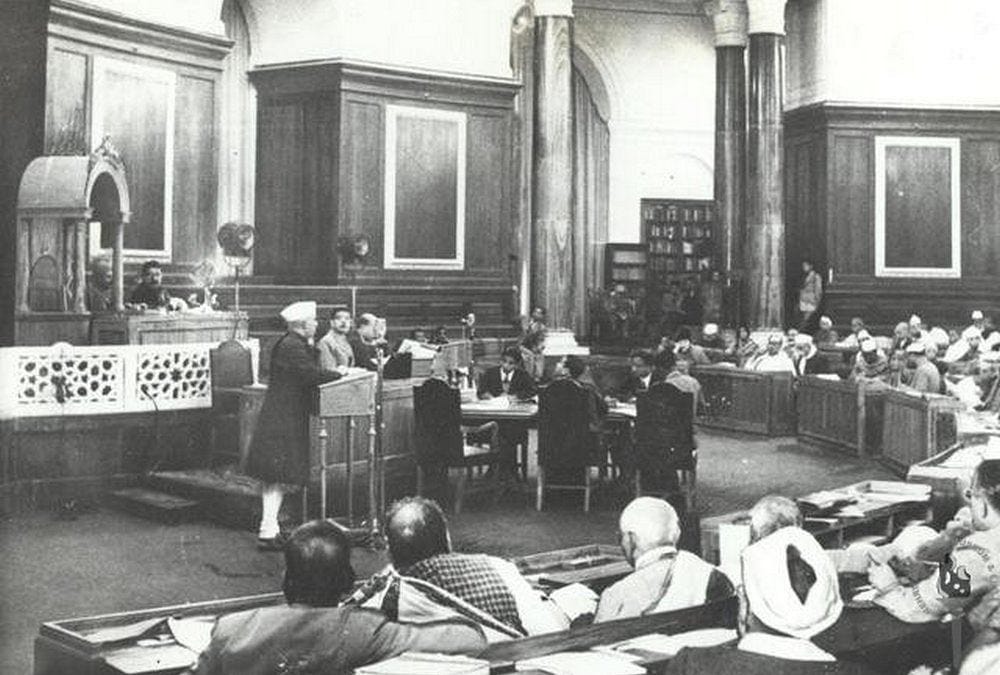
Thus, the Constitution became the tool with which these political leaders set out to honour those unfulfilled promises. The Constitution became a tool for social revolution.
Works Cited
Britannica. “Surat | Textile Hub, Trading Port, Gujarat.” Britannica, https://www.britannica.com/place/Surat. Accessed 19 October 2023.
Haynes, Douglas E., and Frank Conlon. “Rhetoric and Ritual in Colonial India: The Shaping of a Public Culture in Surat City, 1852–1928.”, https://www.researchgate.net/publication/270991245_Rhetoric_and_Ritual_in_Colonial_India_The_Shaping_of_a_Public_Culture_in_Surat_City_1852-1928_By_Douglas_E_Haynes_Berkeley_University_of_Calfornia_Press_1991_xi_363_pp_4295. Accessed 19 October 2023.
Lovely Ashwin. Left me wanting more