


I recently had the distinct privilege of writing a chapter for the Hindu’s book titled India and the Second Space Age.
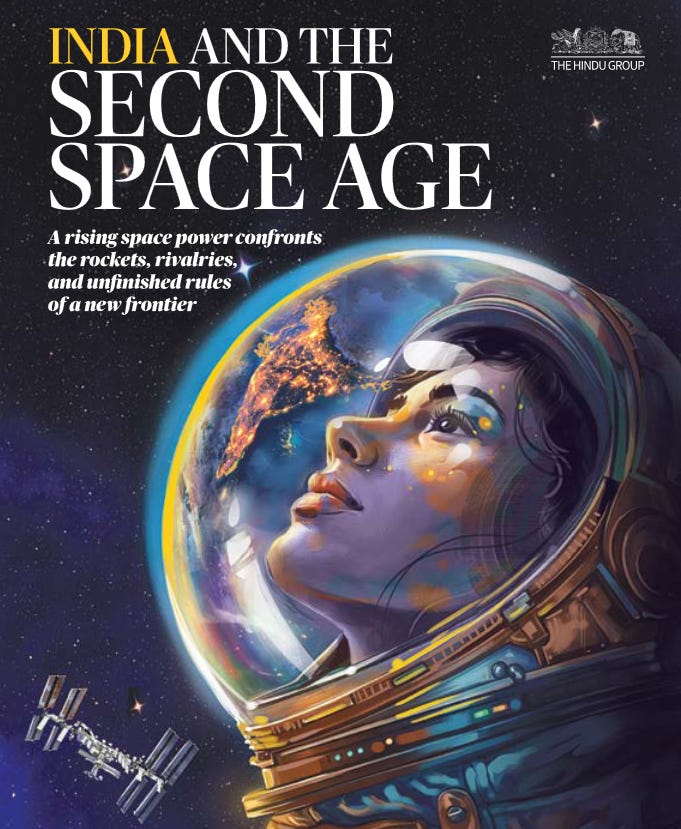
My chapter was about the frugality of Indian space programme that we hear so much about. India launched Chandrayaan at a cost less than the budget of the movie Gravity. Indian mission to Mars was cheaper than the movie Interstellar.
This ability to achieve successful space missions with shoestring budgets started off as an effective political economy tool to the early Indian governments that had to justify spending crores on space missions instead of addressing health and hunger. Now, it has become bragging rights and often a brand identity for all of Indian endeavors in space.
The India that used this frugal strategy is different from the India we live in today. The country is now more prosperous, more ambitious and more capable. Then, the question that we should ask ourselves is: do we want to hold on to this identity in the present and for the future? Does it afford us the chance to be audacious that our ambitions demand?
These are the questions that I tried to answer in this book chapter. Here are glimpses of the arguments I make:
… ISRO’s frugality is not an inherent trait of the organisation, but a mathematical outcome as a result of a narrow objectives, simpler designs and testing through software simulations…
… This worked well for a world where ISRO only needed to launch a handful of rockets each year. Each launch was a national event. Each rocket was like a handmade product. That world is gone. Today, India needs to launch twenty or thirty times a year at the least. It is not there yet and is actively trying to close the gap. ISRO is changing to make this happen…
… The routine manufucturing and operational responsibilities will be transferred to the private sector. By harnessing the industrial scale of the private sector, the hope is that more of the commercial value of these technologies can be realised. Meanwhile, ISRO will only focus on the cutting edge, the projects that will push the boundaries of Indian technological capabilities in space like the new more powerful rocket or taking Indians to space…
… In other words, ISRO’s job now is to push into territory where failure is likely, timelines are uncertain, and the returns are measured in capability rather than cost-per-kilogram…
… For decades, ISRO’s identity, in the public imagination has been built around the word frugal. Frugal engineering. Frugal innovation. Missions cheaper than Hollywood films. But a research organisation that pushes frontiers cannot optimise for frugality. It must optimise for ambition. And after half a century of being rewarded for keeping costs down, it is not clear that ISRO has the institutional instinct or the sociopolitical permission to spend boldly, and when necessary, to fail expensively…
… None of this is to say the frugal era was a mistake. It was one of the great institutional achievements of post-independence India. A country that transported its first sounding rocket on a bicycle built a space programme that reached Mars on its maiden attempt, landed near the lunar south pole before anyone else, and launched satellites for thirty-six countries at prices no one could match. The engineers who did this deserve more than the word frugal. They deserve the word brilliant…
… Today, India is more prosperous, more ambitious and capable. The next decade asks something different. It asks ISRO to build a space station. To put Indians on the Moon. To develop rockets that land themselves and fly again. These are not tasks that reward the cheapest possible approach. They reward the fastest learning cycle, which means the willingness to build, break, rebuild, and break again, all in public, at great expense, with no guarantee of success…
… The word frugal will have to change its meaning if it is to remain useful. It cannot keep meaning cheap. It must come to mean disciplined—an institution that spends carefully not because it fears spending but because it respects what it is spending on. There is a difference between an organisation that avoids waste and an organisation that avoids risk. ISRO has always been the former. It must not become the latter.
You can buy the book on Amazon here.
If you cannot buy the book and wish to read the chapter, here is my draft of the chapter.
This clearly shows how ISRO has been functioning and what their priorities have been. Maybe first time someone is writing about this, lots of TIL moments
Well written.