


The Orrery is a fortnightly newsletter on space power and policy, written from an Indian seat. Every edition will have one analysis of the most consequential development in the space domain.
It is somewhere in the Zaporizhzhia region, on a clear summer night. Ukrainian soldiers prepare a small winged drone in the red glow of their headlamps. After loading the warhead with high explosives, the drone is catapulted into the darkness. It flies southeast towards Russian-occupied Crimea before disappearing into the night. Its target is a Russian base.1
Across Russian-held southern Ukraine and Crimea, drones like it have been ghosting past the defences, reaching the Russian rear and hammering fuel depots, air-defence systems and trucks carrying supplies towards the battlefield. Some of these strikes reach as deep as 180 km behind the Russian frontlines—far beyond the reach of direct radio link. Even at those distances, the pilots from Ukrainian unmanned-systems regiments can see through the drone’s camera and steer it towards their target. They are maintaining connection with the drones using something remarkably ordinary: the internet.2
Most of these drone attacks are flown using the Starlink megaconstellation. Somewhere aboard the drone sits a terminal that connects it to satellites overhead. The satellite connection allows commands and live video to travel between pilot and drone. From the drone’s point of view, it is simply connected to the internet, indifferent to the fact that the connection is coming from satellites. That is what makes a megaconstellation fundamental and powerful—it is a vast space infrastructure that is, at the end, just another internet service. Through the internet, it is able to work with phones, laptops, cameras and increasingly—drones, sensors, and military command systems. A megaconstellation does not require individual users, governments, enterprises and militaries to integrate or buy into an entirely new technology. All users are just connecting the devices they already have to the network that already binds the modern world together.
The differences between ground-based internet and satellite internet become apparent during crises. A ground-based network must already exist where it is needed. In remote border regions, open seas and other far-flung places of economic or military interest, ground-based internet is often absent. Even where present, its towers can be destroyed and its fibre can be cut easily. Satellites in a megaconstellation are not chained to any terrain or hemmed in by any border. When fighting begins in a valley between mountains, at the heart of a desert or in a stretch of an ocean, the satellites do not need to be sent there. They are already passing overhead.
The economic and military power lent by such a sweeping communication network is increasingly being treated as an element of national power. The US Space Force’s old model of a few large communications satellites is considered ill-suited for contested war. It is moving towards a much larger network of satellites spread across providers and orbits. Under its Warrior Plans programme, the Space Force has recently started buying commercial low Earth orbit internet services for military use.3
India finds itself in different circumstances without a domestic megaconstellation yet. Foreign megaconstellations are knocking on its door. This week, the government cleared key satellite-spectrum terms, bringing systems such as Starlink and Eutelsat OneWeb closer to active service in the country. At almost the same time, reports said Reliance Jio was targeting September 2027 for the first test flight of its planned 1,600-satellite constellation. The project has already got IN-SPACe’s nod and has been filed with the International Telecommunication Union.4
There is clearly value in gaining access to a foreign megaconstellation’s services. But it is not the same as having one rooted at home—built and operated by domestic companies, supported by domestic industry, and aligned with the geopolitical interests of the home state.
This edition shows what such a megaconstellation adds to the power of the state behind it. Beyond unshackling the internet infrastructure from geography, there are four main strategic gains:
Staying power
Industrial strength
Orbital presence
Freedom of action
1. Staying power
Megaconstellations show considerably more staying power than the US Space Force’s older model of a few large satellites. With their military value, megaconstellations inevitably invite countermeasures. An adversary can target the space segment—attack the satellites or launch cyberattacks; or the ground segment—jam the radio signals for users on the ground.
Megaconstellations are particularly resilient to attacks on the space segment. They can withstand losing individual satellites. Taking one out is like plucking one bird from a vast flock. The gap in the network does not stay open. Another satellite soon passes overhead and users shift their connection to it. The data gets rerouted through another path. Even several losses may thin the flock without bringing it down. The US Space Force has a term for this: self-healing. Trying to destroy many satellites creates a different problem. Knocking out hundreds or thousands of satellites would scatter cascading debris. This may threaten all spacecraft in those altitudes, including those of the attacker. The scale of destruction required to knock down a megaconstellation risks poisoning the orbit entire.5
Countermeasures targeting the ground segment fare better. Jamming on the ground is effective over a limited area. Starlink terminals use GPS to locate themselves before connecting to satellites. Russia exploited this by jamming GPS signals to disrupt Ukrainian use of Starlink. In 2022, SpaceX pushed software changes that allowed Starlink terminals to keep working despite some forms of Russian jamming. Russia has now developed specialised jammers that can disrupt Starlink over an area of roughly 20 square kilometres. But the jammer has to stay in place and keep transmitting, making it a target in its own right. At best, jamming can carve out a temporary dead patch beneath a network that still stretches far beyond it.6
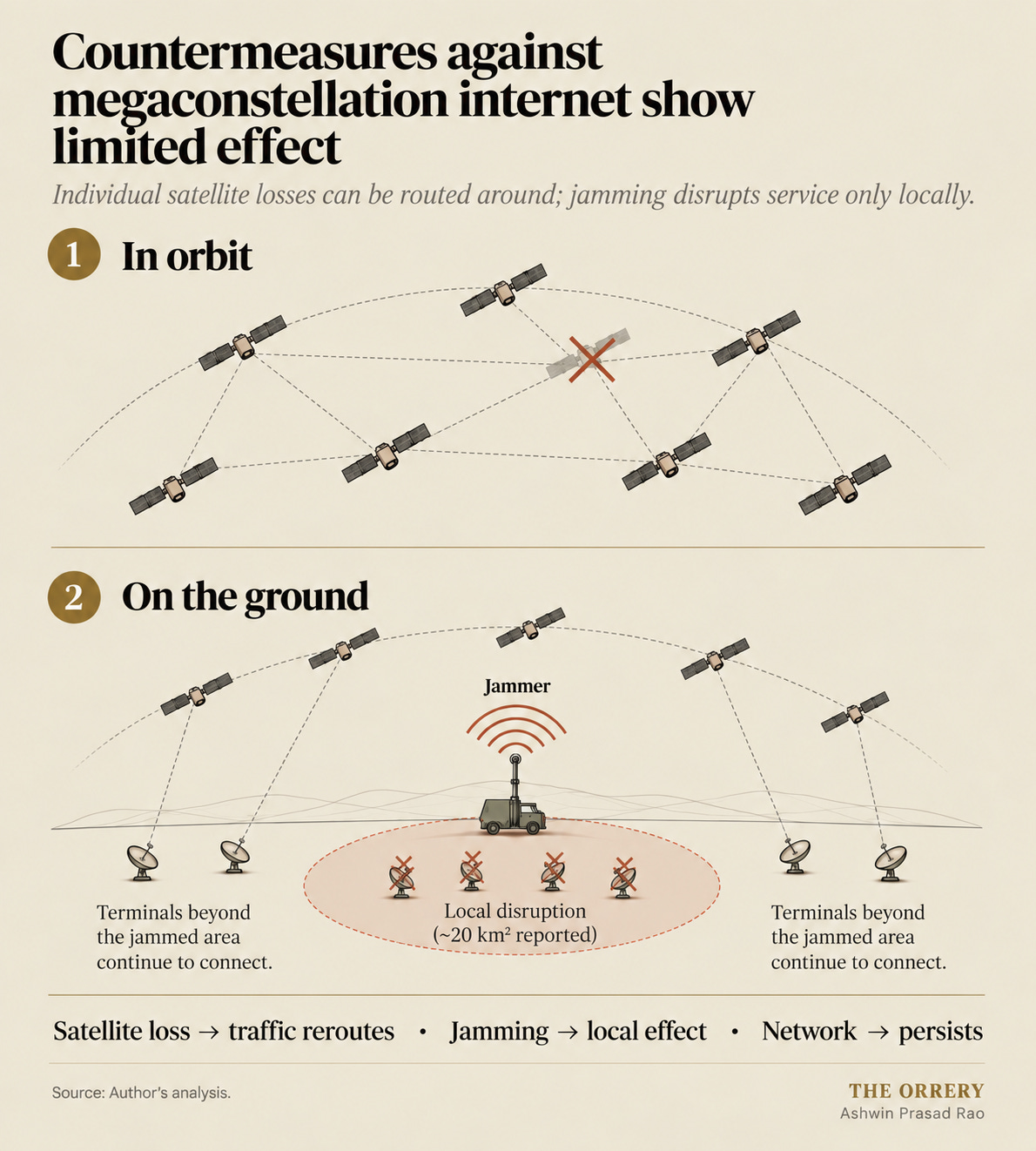
The cycle of measures and countermeasures in war makes megaconstellations more seasoned. Lessons from Russia and Iran can be folded into newer Starlink satellites and terminals through better processors, antennas, battle-tested firmware and other improvements. So the early megaconstellations get better over time.7
Lastly, the staying power also depends on replenishment. Satellites in a megaconstellation are relatively short-lived by design and losses have to be replaced. Sustaining the network therefore depends on industrial strength.
2. Industrial strength
Megaconstellations can create a large industrial base around them. They need a steady supply of satellites and other components, which requires large-scale manufacturing facilities. Batches of these satellites need to be launched frequently, creating steady demand for launch capacity.
The rise in industrial power is greatest when demand for both satellite manufacturing and launch is fulfilled domestically. The clearest example of this comes from the Chinese Qianfan megaconstellation, operated by SpaceSail. Around Qianfan’s base in Shanghai’s Songjiang district, a commercial-space industrial park has drawn more than 70 aerospace companies. Qianfan has also created launch orders for private rocket firms such as LandSpace, Space Pioneer and CAS Space. LandSpace has won launch orders for the state-owned Guowang constellation as well. In August, LandSpace’s Zhuque-3 became the first privately developed Chinese orbital rocket to recover its booster after launch. The company expects the reusable rocket to help meet the launch demand of these megaconstellations.8
Demand not captured domestically will strengthen another country’s industrial base. In August, Canada awarded Telesat an initial C$2.3 billion contract for military communications in the Arctic. The order immediately expanded Lightspeed from 156 satellites to 225; the additional 69 will be built by MDA Space at its high-volume factory in Montreal. The Canadian government explicitly places the programme inside a wider push for strategic autonomy and reducing dependence on foreign suppliers. But Canada does not have orbital-class rockets now. Lightspeed’s first satellites are therefore contracted to fly on SpaceX. Canada can capture the constellation and manufacturing value. For now, part of the launch value still leaks south across the border.9 Similarly, in the case of Amazon Leo, a large part of its launch demand has gone to Europe. Its original order consisted of 18 Ariane 6 launches, which was the largest commercial contract in Arianespace’s history. This week, Amazon increased that to 24 launches through 2031. Arianespace says the long-term order is helping ramp up Ariane 6 production. That dependence also ties the constellation’s growth to the health of a foreign launch industry. Delays to Ariane 6, along with New Glenn and Vulcan, played a role in delaying Amazon Leo’s own deployment. With Jio planning its constellation build-out from 2028, it will have to confront similar trade-offs as Telesat and Amazon in the absence of a strong domestic manufacturing and launch industry in India.10
This industrial demand does not disappear once the megaconstellation is up and running. Megaconstellations continuously shed satellites and need replacements. Out of the 10,749 Starlink satellites launched by the end of 2025, 1,353 had already re-entered the atmosphere and burnt up. They were not all failures; many were retired as planned. Even so, the numbers give a sense of the industrial effort needed to keep a megaconstellation alive. The demand for manufacturing and launch is recurring and endless.11
Much of this industrial base is sustained by civilian customers at home and abroad. In the first half of 2026 alone, Starlink’s consumer business generated $4.633 billion for SpaceX.12 This civilian demand keeps factories, suppliers, engineers and launch pads busy in peacetime.
When war breaks out, the same warm production lines can satisfy wartime appetites for replacement satellites, components, and launch. The state can draw military capability from an industrial machine it did not have to build or sustain on its own. The US Space Force’s first Warrior Plan task order in May went to SpaceX for Starshield services; the second went to OneWeb. 13 Starshield is SpaceX’s secure satellite network designed for government and military use.
3. Orbital presence
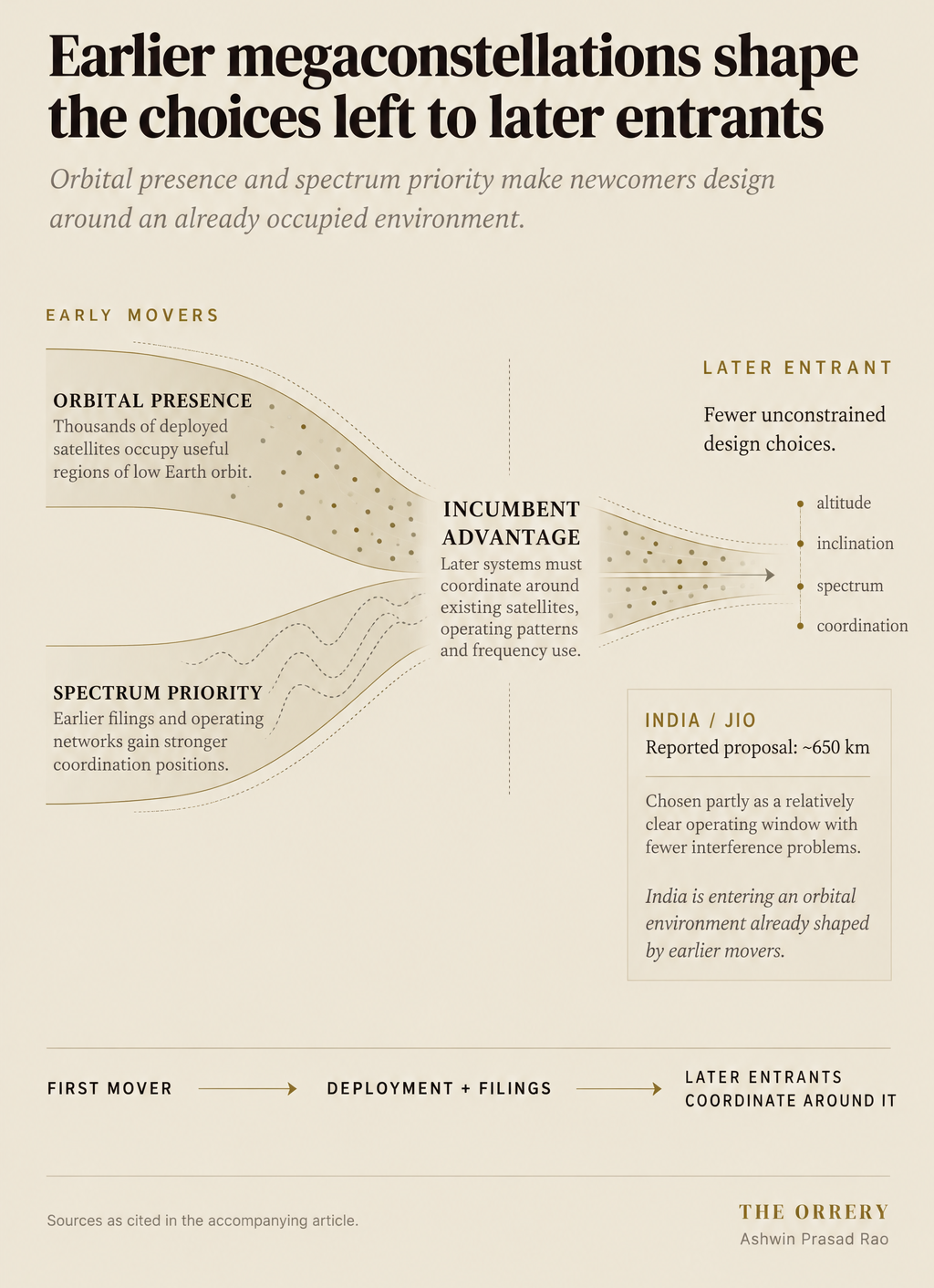
Megaconstellations give themselves a positional advantage in orbit. Thousands of their satellites fill up the most useful parts of low Earth orbit. Their operators gather valuable frequency spectrum rights. New satellites must then fit themselves around the megaconstellations with the best orbital and frequency resources. This gives megaconstellations a powerful incumbent advantage that begins to define the entire domain. I have called this orbital entrenchment before.14
Other megaconstellations are already constraining India’s orbital choices. For its constellation, Jio is reportedly looking at an altitude of around 650 kilometres. One reason given for choosing that altitude is that it is a relatively clear layer with fewer interference problems. Even before launch, an Indian system is having to choose its place around the orbital presence of those that have already claimed the more favourable resources.15
Megaconstellations can use their orbital presence as a footing for entirely new capabilities. SpaceX’s Stargaze system is an early example. Starlink satellites already carry star trackers to work out their own orientation. SpaceX now uses nearly 30,000 of those trackers to record roughly 30 million passes of nearby objects every day. In addition to satellite internet, the Starlink megaconstellation has become a vast space-surveillance network. Separately, new research shows that Starlink’s signals could be used as positioning, navigation, and timing signals like GPS.16
4. Freedom of action
Satellite internet service from megaconstellations can be extended to other countries remarkably quickly. Disaster response, remote schools, hospitals, ships, isolated industries and poorly connected communities all give compelling reasons for foreign governments to adopt it.
This temptation is strongest where ground-based internet is weak. Political incentives often favour the satellite internet solution over the slower, more expensive task of domestic infrastructure. China’s SpaceSail is using this logic to enter overseas markets. It has an agreement in Brazil with state-owned Telebras to provide connectivity in isolated and underserved regions. Brazil has also discussed using SpaceSail alongside ground-based internet to connect schools, hospitals, and other public institutions. In Malaysia, SpaceSail’s agreement with MEASAT covers broadband, direct-to-device links, connected devices and Earth observation. In Türkiye, its agreement with Türksat covers multi-orbit services for sectors including energy, mining, maritime and aviation. Qianfan is specifically aimed at the overseas markets from the Belt and Road Initiative.17
Megaconstellations can also become alliance infrastructure, binding strategic allies more tightly together. Britain already operates its own military communications satellites through the Skynet programme. And still, its Ministry of Defence has spent nearly $40 million on SpaceX services like Starlink and Starshield. The UK is the first country besides the US to acknowledge using it.18
Reliance by other governments, militaries and institutions gives the state behind the megaconstellation enormous political clout. A government that has come to depend on foreign satellite internet for its schools, businesses, emergency services or military will come to value it deeply. Access becomes tied to the wider bilateral relationship. The access control can also be selective. It can approve one terminal and block another, draw boundaries around where the service works, or treat different users differently. SpaceX showed this is possible when Russian forces began using illicit Starlink terminals. A whitelist was created and unregistered users were cut off. Within days, terminals used by Russian forces had been blocked. The satellites above both armies were the same.19
Constellations like Europe’s IRIS² and China’s Guowang are sovereign reactions to this dependence and competition. ESA describes IRIS² as a way to strengthen European strategic autonomy and allow independent action. In August, the EU accelerated the programme. It expanded the constellation to 348 satellites and increased the secure capacity reserved for governments. In China, Guowang is being built by China SatNet, a central state-owned enterprise created specifically to develop the country’s national satellite internet network. Beijing has treated the programme as a national strategic priority. RAND describes it explicitly as a military counter to Starlink.20
Megaconstellations are therefore more than the sum of their parts. Their scale gives them serious staying power, keeps industrial production lines warm, secures an enduring orbital presence and gives the state behind them influence far beyond its borders.
India has no reason to reject foreign megaconstellations simply because they are foreign. But as domestic constellations begin to take shape, Indian policy should ensure that, to the extent that is possible, much of the resulting manufacturing, launch and other industrial demand is captured at home. Otherwise, India risks building a megaconstellation without retaining much of the strategic value that makes one worth having.
A new edition of The Orrery is published every fortnight. Ashwin Prasad Rao is Staff Research Analyst at the Advanced Military Technologies and Outer Space programme at the Takshashila Institution. The Orrery is personally owned and written; the views are his own.
The opening scene is a creative reconstruction based on reported details from Max Hunder, “Russia tries to jam Musk’s Starlink systems to counter Ukrainian drones”, Reuters, 8 July 2026. ↩
Vladyslav Smilianets and Valentyn Ogirenko, “On the ground with Ukraine’s drone forces targeting Russia’s battlefield rear”, Reuters, 28 May 2026; Max Hunder, “Russia tries to jam Musk’s Starlink systems to counter Ukrainian drones”, Reuters, 8 July 2026. ↩
Gen. B. Chance Saltzman, “Remarks by CSO Gen. Chance Saltzman at the 2026 Space Symposium”, U.S. Space Force, 15 April 2026; U.S. Department of Defense, “Exception to Fair Opportunity – Warrior Plan 1 (SBS005506)”, SAM.gov, 10 June 2026. ↩
PTI, “Digital Communications Commission approves Trai recommendations on satcom spectrum”, The Economic Times, 8 September 2026; Kiran Rathee, “ET Exclusive: Reliance Jio eyes September 2027 test flight for 1,600-satellite LEO network”, The Economic Times, 8 September 2026. ↩
Gen. B. Chance Saltzman, “Remarks by CSO Gen. Chance Saltzman at the 2026 Space Symposium”, U.S. Space Force, 15 April 2026; Ashwin Prasad Rao, “Orbital Entrenchment”, Takshashila Discussion Document 2025-32, 19 December 2025. ↩
Ashwin Prasad Rao, Aditya Ramanathan, and Col. Das (Retd.), “Starlink and Risks for India”, Takshashila Discussion Document 2026-12, 12 April 2026; Max Hunder, “Russia tries to jam Musk’s Starlink systems to counter Ukrainian drones”, Reuters, 8 July 2026. ↩
For documented wartime interference, adaptation and operational experience involving Starlink in Ukraine and Iran, see Ashwin Prasad Rao, Aditya Ramanathan, and Col. Das (Retd.), “Starlink and Risks for India”, Takshashila Discussion Document 2026-12, 12 April 2026. ↩
Songjiang District Government, “Qianfan Constellation reaches 200 satellites in orbit”, n.d.; Andrew Jones, “LandSpace secures launch contracts for China’s megaconstellation projects”, SpaceNews, 9 January 2026; “China’s LandSpace lands rocket booster; joins SpaceX, Blue Origin with reusable tech”, Reuters, 19 August 2026. ↩
Defence Investment Agency, Government of Canada, “The Government of Canada awards a military communications contract to support Arctic sovereignty and national security”, 4 August 2026; Telesat, “Telesat secures $2.3 billion Arctic military satcom contract, expanding Telesat Lightspeed network and capacity by 44%”, 4 August 2026; Government of Canada, “Canada’s Defence Industrial Strategy”, 2026. ↩
Charles Clark, “Amazon Leo adds 6 new Arianespace launches, expanding its launch partnership”, Amazon, 10 September 2026; Kuiper Systems LLC, “Request to Extend or Waive Interim Milestone for the Amazon Leo Constellation”, filing before the Federal Communications Commission, 30 January 2026; Kiran Rathee, “ET Exclusive: Reliance Jio eyes September 2027 test flight for 1,600-satellite LEO network”, The Economic Times, 8 September 2026. ↩
Indian Space Research Organisation, “Indian Space Situational Awareness Report (ISSAR) for 2025 Released”, 16 April 2026. ↩
Space Exploration Technologies Corp., Form 10-Q for the six months ended 30 June 2026, filed with the U.S. Securities and Exchange Commission, 4 August 2026. ↩
U.S. Department of Defense, “Exception to Fair Opportunity – Warrior Plan 1 (SBS005506)”, SAM.gov, 10 June 2026; U.S. Department of Defense, “Exception to Fair Opportunity – Warrior Plan 2 (SBS005507)”, SAM.gov, 18 June 2026. ↩
Ashwin Prasad Rao, “Orbital Entrenchment”, Takshashila Discussion Document 2025-32, 19 December 2025. ↩
Kiran Rathee, “ET Exclusive: Reliance Jio eyes September 2027 test flight for 1,600-satellite LEO network”, The Economic Times, 8 September 2026. ↩
Starlink, “Stargaze: SpaceX’s Space Situational Awareness System”, n.d.; Wenkai Qin, Mark L. Psiaki, John R. Bowman, et al., “Pilots and other predictable elements of the Starlink Ku-band downlink”, npj Wireless Technology, volume 2, article 69, 4 September 2026. ↩
Ministry of Communications, Government of Brazil, “Memorandum of Understanding between Telebras and Shanghai SpaceSail Technologies”, 19 November 2024; MEASAT, “MEASAT Partners with SPACESAIL to Advance LEO satellite services”, 6 February 2025; Türksat, “Global Partnership from China for Türkiye’s Satellite Power”, 31 October 2025; Songjiang District Government, “Qianfan Constellation reaches 200 satellites in orbit”, n.d. ↩
Cassell Bryan-Low, “UK deepens reliance on Musk’s SpaceX, spending nearly $40 million on satellite services”, Reuters, 10 September 2026. ↩
Ministry of Defence of Ukraine, “Ukraine rolls out Starlink terminal verification to counter russian aerial terror”, 2 February 2026; Ministry of Defence of Ukraine, “Starlink terminals on the whitelist remain operational, while russian terminals have already been blocked”, 5 February 2026. ↩
European Space Agency, “IRIS² reinforced and accelerated as implementation advances”, 7 August 2026; Howard Wang, Jackson Smith, and Cristina L. Garafola, “Chinese Military Views of Low Earth Orbit: Proliferation, Starlink, and Desired Countermeasures”, RAND Corporation, 2025. ↩
Excellent write up
“This temptation is strongest where ground-based internet is weak. Political incentives often favour the satellite internet solution over the slower, more expensive task of domestic infrastructure.” - what more is left to say? This divides the powers that can try to catch up from those who will be left further behind. Governments that have a holistic development mandate will prioritise or even fast-track filling gaps in terrestrial infrastructure, while those that have assumed a populistic mandate will not.