


The Indian space program is not young but the Indian human spaceflight program is. When people discuss its inception decades and centuries later, they will remember today. An Indian went to space today after 40 years. Perhaps the last Indian on his way to the International Space Station. It is a good time to talk about human space exploration.
I write for the Indian Express in this opinion piece:
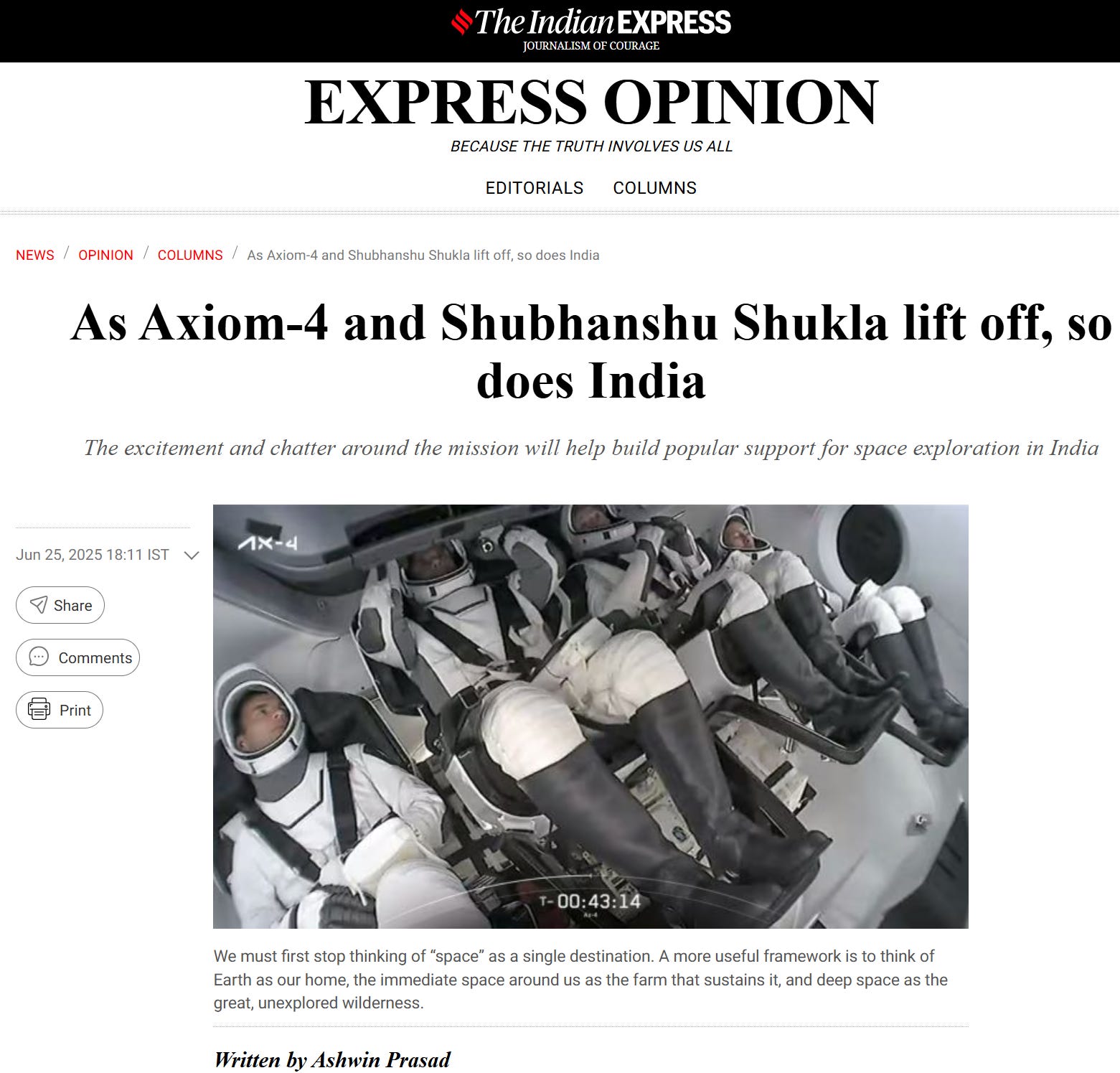
… we must first stop thinking of “space” as a single destination. A more useful framework is to think of Earth as our home, the immediate space around us as the farm that sustains it, and deep space as the great, unexplored wilderness.
The farm (Earth-Space)
The farm is the region around Earth, known as the Earth-Space, where our satellites operate. This farm sustains life in our home. It is not food which is grown here, but data. Modern life depends on this data for everything — GPS for navigation and financial transactions, satellites for weather forecasting and broadcasting, and constellations for the global internet.
The farm is not tended to by humans. Uncrewed technology like satellites and probes are able to do this job far more cheaply and safely. The potential for the data they generate is endless and priceless.
The astronauts we send to this farm through missions like the Axiom-4 and Gaganyaan are not mere passengers. They are pioneering specialists trained to survive beyond the safety of our home and skilled in performing complex tasks and experiments that require human ingenuity and dexterity. Their experience and learning inform their successors who will dare to venture out even further into the wilderness.
The wilderness (outer space)
The Moon, Mars and beyond are fundamentally different from our home and even the farm. They are full of risks and opportunities. Today’s technology cannot use this region for sustenance at home. The costs of accessing the resources here are either too high, take too much time or both. With scientific advancement and technological progress, perhaps our farms can expand to these regions. Or even form a new settlement in the wilderness and go on to build another home and another farm around it. Therefore, the exploration and discovery of the wilderness is necessary to realise the long-term opportunities.
As a part of exploring this wilderness, uncrewed missions like Chandrayaan and the Mars rovers are sent first. They are the “drones” that scout out the region. They map the terrain, identify risks, and locate resources. They go first because it is dangerous and unknown.
However, you don’t build a settlement in a wilderness with scouts alone. You need pioneers. Humans are adaptable, can problem-solve in real-time (the “Apollo 13 moment”), and make intuitive leaps that a pre-programmed rover cannot…
Winning hearts and minds
The human element extends beyond the practical reasons. Great endeavours are powered by human emotion. The story of Shubhanshu Shukla venturing into the cosmos on behalf of his nation captures the imagination of millions. The stories provide a human face to a highly technical and challenging endeavour. They become focal points for national pride and aspiration.
This public imagination is not just a feel-good emotion. It is a strategic asset. Like India-Pakistan cricket matches, it helps societies surpass domestic squabbles. It creates a groundswell of popular support that translates into political will…
The long game
As technological progress accelerates, the question will shift from whether humanity will travel to other planets, to who will travel and write the rules. In this future, human spacefaring capability is no longer just symbolic; it is central to Indian national power and international standing.
The nations that are physically present in the “wilderness” will be the ones who shape the future of humanity in space. They will set the precedents for law, commerce, and ethics beyond Earth. Gaganyaan is India’s entry ticket to having a seat at that table. It is a declaration that India intends to be a rule-maker, not a rule-taker.
Read the full article here: https://indianexpress.com/article/opinion/columns/as-axiom-4-and-shubhanshu-shukla-lift-off-so-does-india-10088066/