


The Orrery is a fortnightly newsletter on space power and policy, written from an Indian seat. Every edition will have one analysis of the most consequential development in the space domain.
Echoes of the 2019 New Year celebrations still lingered in most parts of the world when, nearly four lakh kilometres away, Chang’e 4—a Chinese spacecraft—was descending into the Von Kármán crater on the far side of the Moon. The ramps came down and Yutu-2 rover rolled onto lunar ground where no spacecraft had ever landed.1
Less than three months later, United States Vice President Mike Pence stood in Huntsville, Alabama and declared that America was once again in a space race. He warned that China sought to seize the lunar “strategic high ground”.2 In the following year, the United States led the creation of the Artemis Accords and seven other countries became its founding signatories.
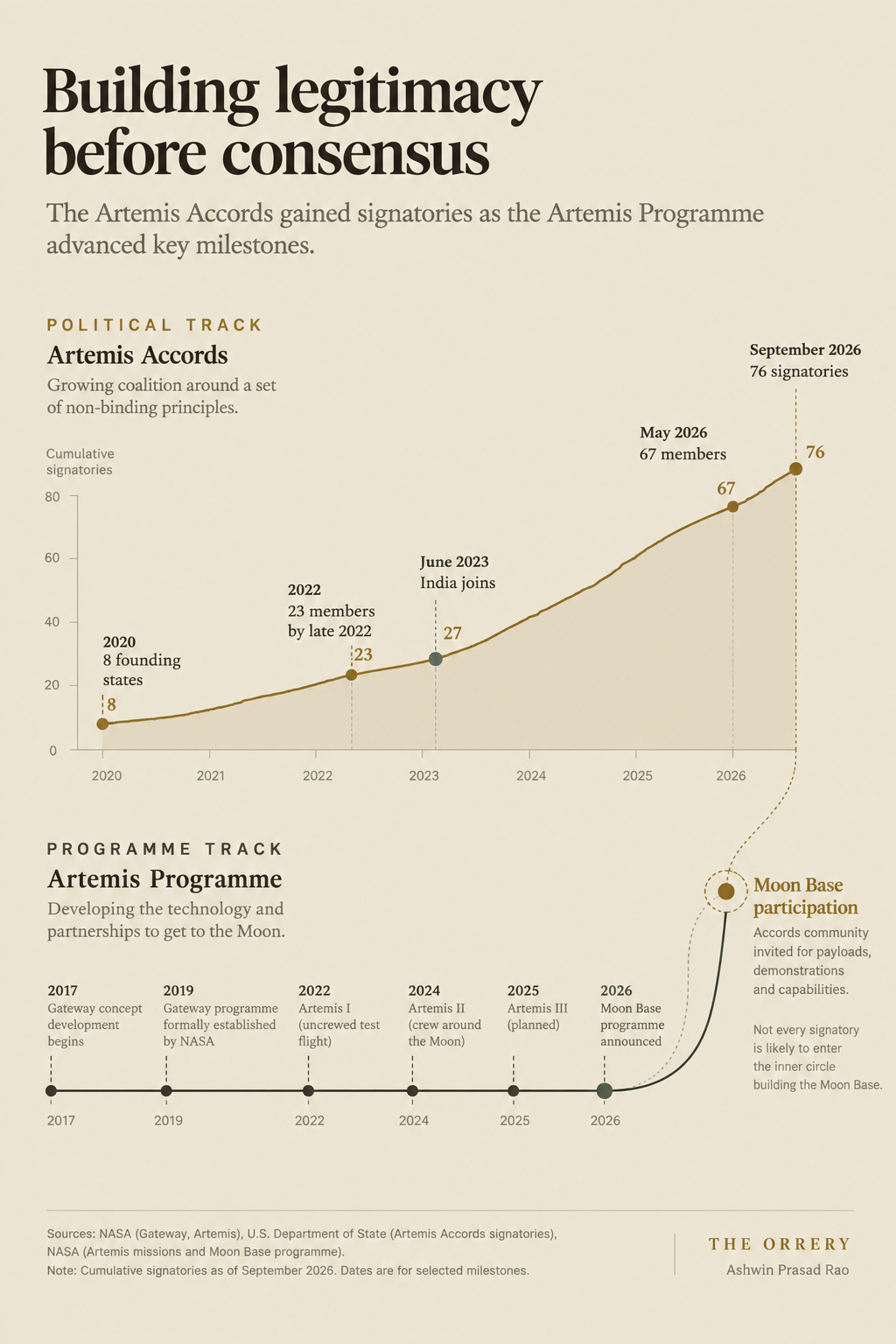
What began as a set of non-binding principles has since become a political vision accepted by 76 countries, including India. Last week, three more nations—Croatia, Côte d’Ivoire and San Marino—joined the Accords over 23–25 September.3 More importantly, the Accords have moved from principles to procedures, and NASA is now inviting the community built around them into its Moon Base programme.
The rules between the rules
The Accords supplied a political vision for governing space activities on the Moon and beyond. They were a US-led answer to emerging questions about outer space governance.
The Outer Space Treaty is a Cold War-era agreement that outlines the foundational principles for space activities. It established that outer space was free to be explored and used, that no country could claim territory and that states had to take account of one another’s activities. But it left many practical questions unanswered. Could a country or company extract resources from the Moon without claiming the territory itself? And what happens when two missions want to operate in the same valuable region? The United States and China both plan long-term lunar operations in the near future. As activity on the Moon increases, those questions become harder to avoid. The Accords sought to provide more specific guidelines for situations like these. Nations that joined the Accords were politically committing to these non-binding rules of behaviour.4
Many provisions of the Accords are straightforward. They reaffirm that activities in outer space should be peaceful, transparent and responsible. They also commit to pursuing interoperable systems so that infrastructure such as communications, power and landing systems can work together.
The more controversial provisions deal with two questions the Outer Space Treaty did not clearly answer. First, can countries and companies use resources from the Moon without effectively claiming lunar territory? The Accords say they can. Second, how should different missions operate near one another without interfering with each other? The Accords call for missions to share information, coordinate their activities and establish temporary “safety zones” around operations where necessary.5 Putting such answers together in an international instrument was a major innovation of the Accords. They were announced when multilateral consensus on these issues did not exist.
The ideas of the Artemis Accords were not wholly outside the positions taken by other major powers. China’s own 2024 submission to the UN accepts that resource use in space is allowable as per the Outer Space Treaty. But one important Chinese objection to the Accords is about the means rather than the end. Beijing disapproves of a US-led group first writing rules by itself. It argues that these positions should be taken after wider discussions through the United Nations.6
Building legitimacy before consensus
Washington deliberately chose this route which was faster and also rather novel. In April 2020, a United States executive order instructed the State Department to build international support for some of the ideas contained in the Accords. It was to be done through joint statements along with bilateral and multilateral arrangements with other nations.7 Rather than wait for consensus under a new universal lunar treaty, the United States would rally willing nations around its interpretation of the existing Outer Space Treaty.
That, in essence, is the geopolitical achievement of the Accords. The United States used its credibility as a spacepower to answer emerging space governance questions. Then, it proposed rules that many countries would find reasonable enough to accept and began building international legitimacy before human activity began on the Moon. When the activity does begin, repeated use of the Accords could turn their principles into standard practices for participating states on the Moon. The Accords also look ahead. The lessons from their practice are intended to contribute to future multilateral negotiations on resource use and deconfliction in space.
A broad coalition, a narrow programme
The Artemis Accords and the Artemis Programme began as two different tracks running towards the same American goals. The Accords developed the political climate that made activities on the Moon worthwhile. The Artemis Programme developed the technology and partnerships needed to get to the Moon. The United States, through NASA, negotiated the Programme partnerships such as astronaut participation and mission responsibilities through separate agreements. The coalition of the Artemis Programme was narrower and older than the Accords. The clearest example of this was Gateway. NASA had been developing the concept since 2017. It formally established the Gateway programme in 2019. The Lunar Gateway was going to be a small station that would orbit the Moon. It would support Artemis crews, scientific research and surface missions on the Moon. In many ways, like the ISS orbiting Earth. Long before the Accords had accumulated dozens of members, America’s traditional space partners, including Canada, Europe and Japan, were working on the Gateway.8
Both tracks were progressing. By late 2022, the Accords had expanded to 23 members. At the same time, Artemis I successfully flew an empty crew module around the Moon. A future version of the module would eventually carry astronauts.9
From principles to practice
In the coming years, the principles were slowly coalescing into processes. In 2023, signatories agreed on basic information that lunar missions should disclose, including planned activities and landing locations. In 2024, they adopted a continuing Method of Operation and worked on issues including non-interference, interoperability and release of scientific data. A 2025 workshop in the UAE even used a tabletop exercise to work through operations in a more complex lunar environment.10 The Accords were no longer merely something governments signed.
From signatories to participants
In 2026, the political and technological tracks started to converge. NASA announced a new Moon Base in March meant to support long-term action on the surface of the Moon. Rovers, communications, power and logistics would precede habitation and progressively longer human stays. The Base effectively displaced the Gateway programme. The focus of the United States had shifted from the lunar orbit to presence on the lunar surface. Until then, Canada, Japan and Europe were developing technology for the Gateway. When NASA changed course, they had no mechanism through the Accords to preserve Gateway. Some of Gateway’s equipment and resources were repurposed towards the Base while the Gateway programme was being wound down.11
Despite these logistical shifts on the ground, the momentum toward the lunar surface was now unmistakable. Just a week after the Moon Base announcement, Artemis II launched toward the Moon, taking three American astronauts and one Canadian astronaut around the Moon and back. A flurry of new Artemis Accord signatures followed over 20 April–7 May, with Latvia, Jordan, Morocco, Malta, Ireland and Paraguay joining. By the end of May, NASA had 67 signatories in total.12 Artemis II gave NASA’s lunar diplomacy a highly visible demonstration of the Artemis programme and its promise.
More revealing than the growing membership was NASA’s changing language around the Accords. In April, NASA officials began explicitly connecting Accords membership with Moon Base opportunities. In May, Administrator Jared Isaacman said NASA was “putting the Artemis Accords into practice with our Moon Base”. When San Marino became the most recent signatory last week, the announcement again said every signatory had been invited to participate in the Moon Base through payloads, technology demonstrations and other capabilities.13 Not every signatory is likely to enter the inner circle building the Moon Base. But NASA is now treating the political community created by the Accords as a recruitment pool for that inner circle. Japan and Korea are good examples of what the inner circle looks like. Japan was a founding Accords signatory and long-standing Artemis partner. For the new surface plans, Japan will supply a pressurised rover for lunar surface operations. Japan’s agreements with NASA also provide Japanese astronauts access to lunar missions. The pressurised rover is part of the second phase of the Moon Base architecture. So Japan is in it for the long haul. South Korea was also an early signatory in 2021. It is now discussing possible roles with the United States in Moon Base communications, navigation, mobility and landers.14
From joining rules to shaping them
India signed the Accords in June 2023. A year before that, in March 2022, India had internally assessed the Accords and considered its options. In 2023, India’s new space policy explicitly permitted Indian entities to recover, possess, use and sell space resources—a position closely compatible with the Accords—before India formally signed two months later.15
The public record cannot tell us whether the Indian Space Policy was written with eventual accession in mind. But it is clear that India had been considering the American vision while undertaking its own space reforms. India ultimately found enough in common with the Accords to sign them rather than insist that these questions first be reopened at the UN. For the United States, that is evidence that the strategy worked. For India, this illustrates the difference between joining a framework and shaping one. If India wants greater influence over the rules governing its future space activities, it will need to put forward its own frameworks before other major powers define the terms. This time, those terms were broadly compatible with Indian interests. The next time, they may not be.
The Moon Yutu-2 rolled onto was, politically speaking, still almost empty. Since then, no human has yet stood there again. But states have already built coalitions, agreed principles, developed protocols and begun deciding how operations in the same parts of the Moon should interact. By the time the lunar South Pole actually becomes a site bustling with human activity, some of its rules may already feel obvious and established.
A new edition of The Orrery is published every fortnight. Ashwin Prasad Rao is Staff Research Analyst at the Advanced Military Technologies and Outer Space programme at the Takshashila Institution. The Orrery is personally owned and written; the views are his own.
China National Space Administration, “China’s Chang’e-4 probe makes historic landing on moon’s far side”, 3 January 2019; NASA, “Yutu 2 on the Farside”, Astronomy Picture of the Day, 5 January 2019.
The White House, “Remarks by Vice President Pence at the Fifth Meeting of the National Space Council | Huntsville, AL”, 26 March 2019; NASA, “NASA, International Partners Advance Cooperation with First Signings of Artemis Accords”, 13 October 2020.
NASA, “NASA Welcomes Croatia as Newest Artemis Accords Signatory”, 23 September 2026; NASA, “NASA Welcomes Côte d’Ivoire as Newest Artemis Accords Signatory”, 24 September 2026; NASA, “NASA Welcomes San Marino Signing the Artemis Accords”, 25 September 2026.
United Nations Office for Outer Space Affairs, “Outer Space Treaty”, 1967; NASA, “The Artemis Accords”, 13 October 2020; China National Space Administration, “SCIO briefing on white paper ‘China’s Space Program: A 2021 Perspective’”, 28 January 2022.
NASA, “The Artemis Accords”, 13 October 2020; Rossana Deplano, “The Artemis Accords: Evolution or Revolution in International Space Law?”, International & Comparative Law Quarterly, volume 70, issue 3, July 2021, pp. 799–819.
People’s Republic of China, “China – Input to the Working Group on Legal Aspects of Space Resource Activities”, A/AC.105/C.2/2024/CRP.5, United Nations Office for Outer Space Affairs, 15 April 2024; Permanent Mission of the People’s Republic of China to the United Nations and Other International Organizations in Vienna, “The General Statement by Chinese Representative at the 69th Session of COPUOS”, 12 June 2026.
The White House, “Executive Order on Encouraging International Support for the Recovery and Use of Space Resources”, 6 April 2020; NASA, “The Artemis Accords”, 13 October 2020.
NASA, “Gateway Space Station”, n.d.; NASA, “Gateway: Frequently Asked Questions”, n.d.
NASA, “NASA Welcomes Nigeria, Rwanda as Newest Artemis Accords Signatories”, 13 December 2022; NASA, “Artemis I”, n.d.
NASA, “NASA Engages in Artemis Accords Workshop to Advance Exploration”, 24 May 2024; NASA, “NASA, Artemis Accords Signatories Progress on Sustainable Exploration”, 18 October 2024; NASA, “NASA Supports Artemis Accords Signatories Advancing Exploration”, 22 May 2025.
NASA, “NASA Unveils Initiatives to Achieve America’s National Space Policy”, 24 March 2026; NASA, “FY 2026 Budget Technical Supplement”, 9 June 2025.
NASA, “Artemis II: NASA’s First Crewed Lunar Flyby in 50 Years”, n.d.; NASA, “NASA Joins Artemis Accords Workshop as Global Signings Rise”, 21 May 2026.
NASA, “NASA Welcomes Paraguay as 67th Artemis Accords Signatory”, 7 May 2026; NASA, “NASA Welcomes San Marino Signing the Artemis Accords”, 25 September 2026.
NASA, “NASA, Japan Advance Space Cooperation, Sign Agreement for Lunar Rover”, 10 April 2024; NASA, “Moon Base Development”, n.d.; NASA, “Republic of Korea Joins List of Nations to Sign Artemis Accords”, 26 May 2021; Korea AeroSpace Administration, “KASA-NASA Artemis Workshop Charts a Joint Path Toward Building a Moon Base”, 31 July 2026.
NASA, “NASA Welcomes India as 27th Artemis Accords Signatory”, 23 June 2023; Indian Space Research Organisation, “Indian Space Policy – 2023”, April 2023; Jatan Mehta, “Moon Monday #132: India and the Artemis Accords, mission updates, and more”, Moon Monday, 19 June 2023; S. Somanath, interview, March 2022, at 15:27.