


In a conversation last month, an acquaintance reminisced about his childhood in the 1970s, fondly recalling his grandmother’s dishes made with millets. This contrasted with my childhood memories, where millets were a rarity. The adults praised them often but rarely did they use them.
Rice and wheat have long been staples of the Indian diet. However, their hegemonic position on our plates has only gained prominence in recent decades, at the expense of other grains. To understand the origins of this shift, one must delve into the early years of our Republic.
Hunger dictates policy
The Indian Republic was born hungry. While the people starved during the Bengal famine of 1943, the British diverted supplies from India to support the war effort. With the partition, India lost a significant portion of its foodgrain-producing belts in Punjab and East Bengal.
In 1946, the Interim Government took control of British India, with Rajendra Prasad as Minister of Food and Agriculture. After independence, one of the first things Prasad did included raising the flag at the Indian Council for Agricultural Research (ICAR) declaring that India’s most pressing task would be to conquer hunger. In the ensuing years, the experiment with collective farming yielded underwhelming results, while land reforms further fragmented landholdings, severely impacting agricultural productivity.1
Following a slew of failed food policies in the 1950s, India embarked on the Green Revolution as a means of achieving food security. The government actively promoted the cultivation of high-yielding varieties of rice and wheat through minimum support price (MSP) and procurement policies.
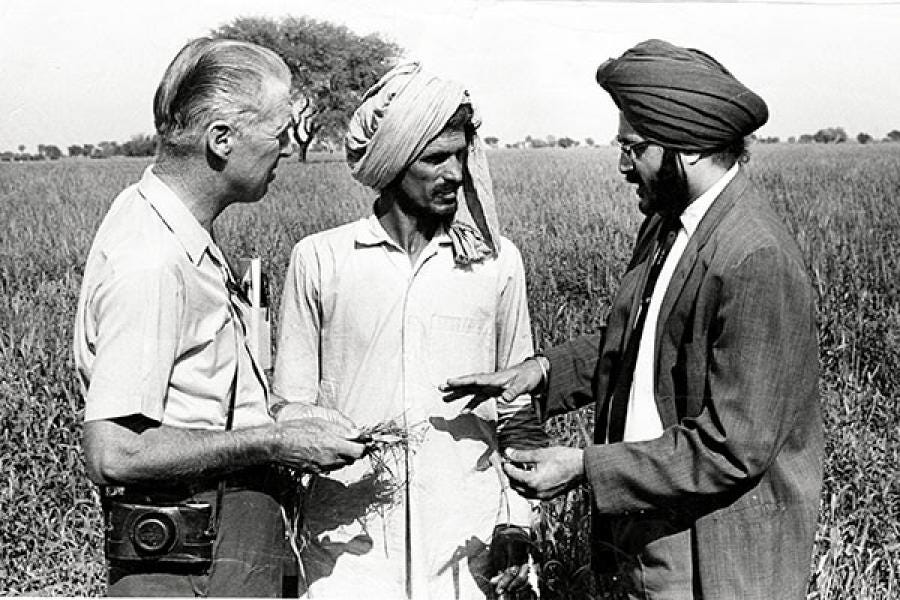
The MSP for rice and wheat grew far more rapidly than that of crops like millets, incentivizing farmers to cultivate these grains even in regions where they were not traditionally consumed.2 This proved effective in addressing Indian food security challenges in the short term. Decades later, these policies in the present context are not sustainable.
Millets Faded into Obscurity
In the years preceding the Green Revolution, millets accounted for 40% of all cultivated grains in India. Today, their share has dwindled to around 6% of the total foodgrain output. Meanwhile, rice production has doubled, and wheat production has tripled in the country. This shift was accompanied by a transformation in the attitudes of urban Indian consumers. Millets, once an integral part of our diet, were relegated to the category of coarse grains, perceived as inferior to the more refined rice and wheat. Millet flour was replaced by wheat flour, and rice became the default grain for direct consumption.3
The decline in millets consumption also meant the loss of their significant nutritional benefits. Apart from being gluten-free, millets are rich sources of calcium, iron, protein, magnesium, vitamin B3, and fiber.4 The advantages of millets over rice and wheat extend beyond cultural nostalgia and nutritional superiority. This aspect will be explored in an upcoming newsletter.
Resurgence of Millets
Today, millets are experiencing a revival. The government is actively promoting their consumption through various programs targeting all stakeholders, ranging from a Production Linked Incentive (PLI) scheme for millets-based food processing industries to promoting millets on the global stage during India's G20 Presidency.5 The UN has declared 2023 as the Year of Millets.
As India faces a growing diabetes epidemic, urban populations are increasingly incorporating millets into their diets. Embracing the healthy tag, many restaurants are fashioning millet-based dishes as rustic offerings in their menus. Their popularity is only expected to rise.
Perhaps, grandparents will soon be feeding their grandchildren millets again, if they aren't already.
https://economictimes.indiatimes.com/news/politics-and-nation/recollecting-indias-frantic-efforts-to-end-starvation-after-independence/articleshow/73618277.cms
https://www.orfonline.org/research/indias-enduring-war-of-water-governance-paradigms/
https://www.businesstoday.in/lifestyle/food/story/millets-and-the-journey-of-the-grain-in-indian-culinary-history-357250-2022-12-21
https://www.icrisat.org/a-short-history-of-millets-and-how-we-are-recognising-their-importance-in-the-modern-context/
https://pib.gov.in/PressReleaseIframePage.aspx?PRID=1947884
Good one Ashwin, looking forward to more such articles.